How “Total Depravity” Ignores the Gospel Call

The TULIP completely ignores man’s responsibility and the gospel call itself. It is, in fact, the TULIP more than any other feature of Calvinism that gives non-Calvinists the impression that Calvinism discourages evangelism and teaches men to wait for God to save them rather than repent and believe the gospel. I would go so far as to argue that Calvinism should discard the TULIP and teach what the Bible says as the authority for what we should believe about Christ in His saving work.

The TULIP focuses exclusively on God’s sovereignty in salvation. But this obsession with the sovereignty of God drifts precariously close to a hyper-Calvinistic overstatement of God’s sovereignty, ala A.W. Pink, who couldn’t appreciate any attribute of God without re-hashing God’s sovereignty all over again. Reading Pink’s Attributes of God, one gets the distinct impression that he sees the sovereignty of God as the one attribute that defines all the others, that sovereignty is more important than God’s holiness or love.

I have no wish to understate God’s sovereignty. God is God, and as an expression of the “Godness” of God, the TULIP seeks to glorify God and to remind us that God doesn’t lay aside His sovereign control when it comes to the salvation of sinners. I am very grateful that God gets all the glory, that salvation is His work, and that I am and have always been in His hand. None of this is a denial of God’s sovereignty. Nor is it a denial that the TULIP includes vital truths about God and His work in saving sinners. I am unwilling to join some of my dear friends in repudiating the TULIP as if it contains no truth whatsoever.

But as I have insisted, the Bible doesn’t resolve the mysterious interaction between God’s will and man’s. God’s will is exhaustive. Of that, there can be no doubt. Man’s will and his entire self have been significantly damaged by sin so that from the time of the Fall onward, man’s heart has been hopelessly corrupted, deceitful above all things, and desperately wicked. To put too much stock in man’s ability would be to set aside what the Bible tells us about ourselves. To diminish God’s sovereignty in our salvation would be to ignore or reject what the Bible teaches us about God. I do not wish to fall into either error.

But we must say what the Bible says, and we must emphasize what the Bible emphasizes. I believe the TULIP goes beyond Scripture in its claims about the interaction between God’s will and man’s.

So much has been written on the TULIP that I couldn’t possibly interact with every explanation or claim. I have two fairly simple presentations of Calvinist soteriology in front of me, both apologetic in nature. The first is Chosen by God by R.C. Sproul. The second is Easy Chairs Hard Words by Douglas Wilson. I recognize that neither of these men has attempted a defense of the TULIP itself, and both provide a substantial explanation of Calvinism that includes the TULIP but doesn’t rely on it. In fairness, both men might agree with some of my critiques. I want to interact with the TULIP itself as it is typically presented since (anecdotally) the TULIP tends to be the go-to expression of Calvinist soteriology. My claim in this article isn’t that Calvinists aren’t more nuanced than the TULIP, but only that the Calvinist reliance on the TULIP is flawed and misguided. And I say this because the TULIP mischaracterizes the gospel by giving only half the story.

Continue reading “How “Total Depravity” Ignores the Gospel Call”

TULIP Trouble

The relation of divine sovereignty to human responsibility is one of the great mysteries of the Christian faith. It is plain from Scripture in any case that both are real and that both are important. Calvinistic theology is known for its emphasis on divine sovereignty – for its view that God “works out everything in conformity with the purpose of his will” (Eph. 1:11). But in Calvinism there is at least an equal emphasis upon human responsibility. (John Frame, Apologetics to the Glory of God, p. 14)

I open with this quote because, first, John Frame is a well-known Calvinist, and second, because he accurately describes here the mysterious interaction between God’s sovereignty and man’s responsibility in salvation. Recently, I placed as the tenth on my list of things I wish would change among Independent Baptists, “overstated anti-Calvinism.” In my explanation of that objection, I said that quite often, in their haste to refute Calvinists, many Independent Baptists caricature Calvinism. In response to that article, some friends asked me to explain my objections to Calvinism, which resulted in an initial post in which I objected to the way Calvinists tend to blur the paradox between God’s sovereignty and man’s responsibility in their presentation of the gospel. Now, I want to raise before you the primary proof that in Calvinism, this paradox is either blurred or ignored.

Photo by Pixabay on Pexels.com

The TULIP does not account for man’s responsibility at all. Period. It gives no consideration to man’s responsibility, and nothing in it would give anyone the idea that man is responsible before God to repent and believe the gospel. If a person learning the TULIP were to take that as the summary of Christian doctrine, they would conclude that man has no part in God’s plan for our salvation other than to wait and hope that God might save him. The TULIP is an effective mnemonic device, for sure. But as far as a summary of Christian doctrine, it falls woefully short. One could argue that the TULIP only gives one side of the coin – later, I will contend that it also goes beyond Scripture in its attempt to describe God’s sovereignty in salvation. But supposing that the TULIP does give one half of the truth, half the truth is not the truth.

Continue reading “TULIP Trouble”

A Critical View of Calvinism

Let me say at the outset that I won’t be interacting with the various Calvinist viewpoints or offering a nuanced critique of hyper-Calvinism v. “high” Calvinism v. “strict” Calvinism. I saw a comic strip on Twitter/X where a Calvinist poked fun at his fellow Calvinists about some of the high-handed intermural debate that goes on between Calvinists themselves. The comic said, “Brothers and sisters are natural enemies, like Arminians and Calvinists, or Lutherans and Calvinists, or Catholics and Calvinists, or Calvinists and other Calvinists.

This isn’t a strange thing. Our church is committed to exclusively using the King James Bible – a position most would describe as “King James Only.” But amongst King James Onlyists, that isn’t nearly enough. I don’t say that the King James Version is inspired, so I’m not really King James Only – I only “use” the King James. And this statement is made with thick scorn heaped upon my head.

Our nuanced opinion is a design feature, fed in part by our unique individuality and in part by our fallenness. And though the work of redemption ought to teach us to hold our viewpoints in humility, we all have those lines that “you shall not pass.” And woe unto that man that crosses our carefully-drawn line.

That said, a hyper-Calvinist will argue that man’s salvation and sanctification and really everything in life is all dictated by God, that man has no choice in anything, that even the suggestion that we should respond to the Gospel is a corruption of the Gospel. “High” Calvinism believes in evangelism because God commands it, but considers it more of a scavenger hunt in search of the elect. According to high Calvinism, God has no desire to save the non-elect. He calls all men to faith and repentance, but for the non-elect, this call only demonstrates that their condemnation is just. God doesn’t love all men, and the atonement of Christ is not available to all men. In other words, the universal offer of the Gospel is more a theory than a reality.

Continue reading “A Critical View of Calvinism”

Jesus Wins!

At Christmastime, we often hear the reminder that Jesus was “born to die.”  And that is mostly true. Of course, he came to die (John 3:14-16).  But He died so that He might live.

Therefore doth my Father love me, because I lay down my life, that I might take it again. (John 10:17)

Jesus died so that He could rise from the dead.  And though we could point to several purposes for His resurrection, the one that fits with our theme is His triumph.  Jesus rose from the dead so He could trounce Satan, who for thousands of years wielded the power of death against humanity. 

Photo by mali maeder on Pexels.com

Forasmuch then as the children are partakers of flesh and blood, he also himself likewise took part of the same; that through death he might destroy him that had the power of death, that is, the devil; And deliver them who through fear of death were all their lifetime subject to bondage. (Hebrews 2:14-15)

In the resurrection, God brought an abrupt end to Satan’s winning record.  Having defeated every man in death, Satan thought He could triumph over the Son of God as well.  And that was his fatal mistake.  Because when Jesus broke the power of death, Satan not only lost that battle, but he also lost the war.  In the resurrection of Jesus Christ, death lost its power over mankind. 

We can delight in Christ if we consider the nature of His triumph.  Notice how Jesus trounced the devil:

Continue reading “Jesus Wins!”

There Went Out a Decree from Caesar Augustus

Luke connects the story of Christ’s birth to the decree of Caesar Augustus.

And it came to pass in those days, that there went out a decree from Caesar Augustus, that all the world should be taxed. (Luke 2:1)

Luke mentions Caesar’s decree for several reasons.  He wants us to know that Mary and Joseph did not travel to Bethlehem on a whim.  Nor did they aim to fulfill the prophecies concerning the birth of the Messiah. Instead, they went to Bethlehem at Caesar’s bidding.

Luke’s reference to Caesar provides historical context.  Historians tell us that Herod the Great somehow offended the Roman emperor Octavian, who ordered the taxing as a reprisal against Herod.  Intending to number the people and later tax them, Octavian required all the people to return to their hometowns.

Because Joseph was of the house and lineage of David, he found himself traveling the entire length of the country with his very pregnant wife, from his hometown of Nazareth in the north to Bethlehem in the south.  A family would not normally undertake such a journey on the final days of pregnancy. Joseph and Mary weren’t choreographing a prophetic fulfillment.  But I don’t believe Luke mentions this primarily for history’s sake.  I think Luke means to remind us of God’s sovereign hand in this entire story.

Octavian was probably the greatest of the Caesars. He brought the Roman Empire to its zenith and was the most powerful man on the earth at the time of Christ’s birth.  And he knew it.

Continue reading “There Went Out a Decree from Caesar Augustus”

Jesus Beats Santa

To be sure, this kind of Christmas ritual was designed largely for children, while Judgment Day was for adults.  Christmas took place once a year, Judgment Day once an eternity.  The “judge” at Christmas was St. Nicholas; on Judgment Day it was God himself.  And both the rewards and the punishments meted out on Christmas – a cookie on the one hand, or a birch rod on the other – were far less weighty than those of eternal joy or eternal damnation.  But the parallel was always there, and always meant to be there.  Christmas was a child’s version of Judgment Day, and its ambiguous prospects of reward or punishment (like those of Judgment Day itself) were a means of regulating children’s behavior – and preparing them for the greater judgment that was to come.[1]

Stephen Nissenbaum, The Battle for Christmas: a Cultural History of America’s Most Cherished Holiday, p. 74
Continue reading “Jesus Beats Santa”

When I was a boy, my dad preached a message he called “Satan’s Claws.”  My dad was an avid doodler, and he loved to preach with a whiteboard marker in his hand.  So, while he preached his message, he drew up a Santa on the whiteboard, and then as he spoke, he kept adding details.  I remember particularly the claw he drew up on the board in that message. 

Immediately after the message, a great purging took place in our home, and for the next few years, Santa Claus was canceled in the Mallinak home.  No Santa hats, no Rudolph, no “Here Comes Santa Claus,” no Bing Crosby.  I think my dad found it tough to eradicate all the Santa references since they tend to be everywhere and in everything at this time of year.  But, he made a valiant effort.  Eventually, as things go, he didn’t feel the need to expunge Santa from the holiday.  But I have never forgotten those “Santa-free” years.

Photo by cottonbro studio on Pexels.com

Every culture develops traditions that reflect and reinforce the values of that culture.  Like it or not, Santa Claus is a cultural symbol.  Our modern-day, Coke-drinking Santa has been loosely connected to the legendary St. Nicholas from the fourth century, but the connections are hard to decipher.  I think of Santa as a modern-day American version of Robin Hood.  The legend of Robin Hood is loosely connected to an actual historical figure and shows up in a variety of ancient English Literature.  But somewhere along the line, Robin Hood became a cultural icon, representative of some of the virtues that English culture came to value.  Even so, Santa Claus.

The American version of Santa Claus, which has become the default version worldwide (due to our status in the world), started with a loose attachment to the ancient St. Nicholas. Once popularized, it quickly detached from the historical figure.  According to Stephen Nissenbaum in his book The Battle for Christmas, the very wealthy John Pintard spent an unhappy New Year’s Eve in 1820 as a band of ruffians stood outside his house making a very loud and peculiar form of music that involved banging pots and pans and singing off-key for several hours.  His daughter was frightened by the sound of a back door to their house opening, and in the morning, it appeared that several of the hooligans had broken into their home.  Such was the tradition of that time.  The rich and powerful enjoyed much ease and leisure during the holidays, while the poor and destitute struggled to provide food for their families.  To “even the score,” the poor would infiltrate wealthy neighborhoods late at night to harass the rich.  If the poor couldn’t enjoy their luxury, they could at least rob the rich of their peace of mind. 

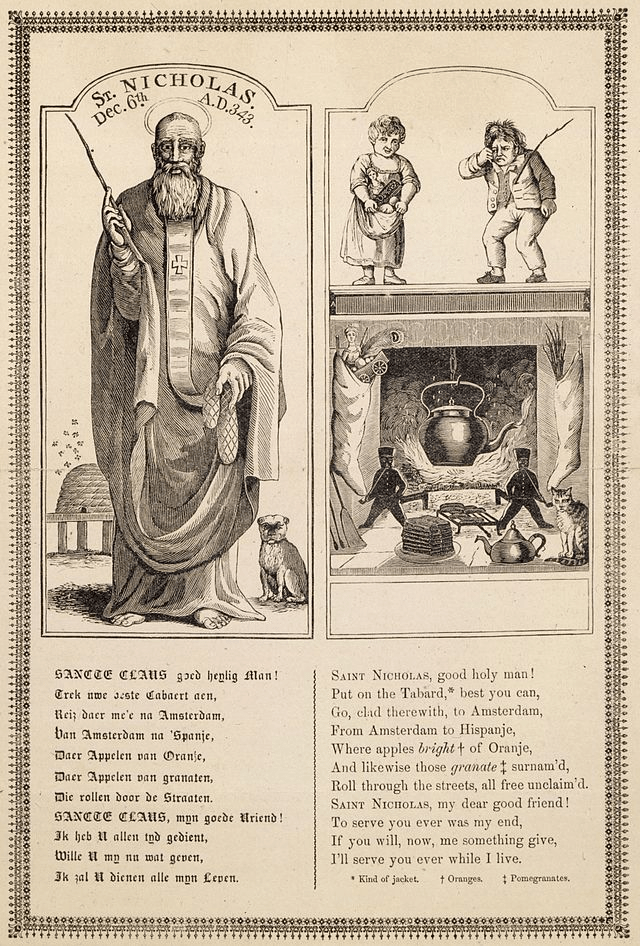
To comfort his children, the next year Pintard commissioned a broadside of St. Nicholas, who he pictured as an Episcopal bishop.  The broadside included a very large picture of the bishop, complete with halo and scepter, then in the next frame a picture of a happy, giggling girl with her apron full of presents and a sobbing, crying boy who looks as if he has just been chastised.  Beneath the picture, a poem promises Saint Nicholas, “If you will now me something give, I’ll serve you ever while I live.”

Pintard belonged to a group of New Yorkers called the Knickerbockers, which included such imminent men as Washington Irving and Clement Clarke Moore, the author of “A Visit from St. Nicholas.”  Pintard is credited with inventing Santa Claus, and Washington Irving with popularizing him.  Initially, Pintard pictured St. Nicholas as a judge, come to reward the good and punish the evil.  Nissenbaum describes Pintard’s Santa as a teaching tool for children.

To be sure, this kind of Christmas ritual was designed largely for children, while Judgment Day was for adults.  Christmas took place once a year, Judgment Day once an eternity.  The “judge” at Christmas was St. Nicholas; on Judgment Day it was God himself.  And both the rewards and the punishments meted out on Christmas – a cookie on the one hand, or a birch rod on the other – were far less weighty than those of eternal joy or eternal damnation.  But the parallel was always there, and always meant to be there.  Christmas was a child’s version of Judgment Day, and its ambiguous prospects of reward or punishment (like those of Judgment Day itself) were a means of regulating children’s behavior – and preparing them for the greater judgment that was to come.[1]

Stephen Nissenbaum, The Battle for Christmas: a Cultural History of America’s Most Cherished Holiday, p. 74
Continue reading “Jesus Beats Santa”

The Gospel Preached to the Serpent

And I will put enmity between thee and the woman, and between thy seed and her seed; it shall bruise thy head, and thou shalt bruise his heel.  

Genesis 3:15

Theologians call it the “protoevangelium”– the first gospel sermon ever preached.  After Adam and Eve sinned, when God heard the facts in the case, this was His immediate response.  God made a glorious promise, and our Christmas celebrations mark the opening act in fulfilling that promise.  As we rejoice in Christ over this Christmas celebration, we might find some bonus delights in this earliest gospel promise.  Here are a handful of points to consider.

The gospel was first announced as a curse.

When God asked Adam what he had done, Adam pointed at his wife and his wife pointed at the serpent.  Then, the Lord pronounced judgment on the serpent.

Photo by Anil Sharma on Pexels.com

And the LORD God said unto the serpent, Because thou hast done this, thou art cursed above all cattle, and above every beast of the field; upon thy belly shalt thou go, and dust shalt thou eat all the days of thy life: And I will put enmity between thee and the woman, and between thy seed and her seed; it shall bruise thy head, and thou shalt bruise his heel.  

Genesis 3:14-15

The serpent’s curse brought Adam and Eve hope.

Imagine them standing before God, trembling and ashamed for their sin, waiting for God to announce His judgment against them.  They knew God’s law:

And the LORD God commanded the man, saying, Of every tree of the garden thou mayest freely eat: But of the tree of the knowledge of good and evil, thou shalt not eat of it: for in the day that thou eatest thereof thou shalt surely die.  

Genesis 2:16-17

The criminals stood in dread, waiting for God to pronounce the death sentence.  God sentenced the serpent first, and the curse on the serpent brought hope to the other criminals.  Because the judgment on the serpent gave the first hint of a Savior for mankind.[1]  How could there be enmity between the serpent and the woman if the death sentence was immediately executed?  And how could there be a “seed” of the woman if the woman was put to death?  And how could the woman’s seed bruise the serpent’s head if the law was carried out against her?  This curse on the snake must have given Adam and Eve their first hint that God had prepared grace for them.

Here was the dawning of the gospel day.  No sooner was the wound given than the remedy was provided and revealed.[2]

God cursed Satan with the promise of a Savior.

Continue reading “The Gospel Preached to the Serpent”

A Gospel Message

To the readers of this blog: this is a draft of a letter we intend to mail to homes in our area if they are not home after two visits during our door-to-door canvassing efforts or if they have a “no soliciting” sign on their door. As a matter of policy, we do not knock on doors when they post “no soliciting” as we desire to respect the private property of those we would engage in gospel witness. The following letter will be mailed to their home instead.

I am asking you the reader to give me some feedback on this letter. Do you believe the gospel is presented clearly in the letter? Do you believe the letter to be engaging enough that people will read it? Do you think that a reader could understand the gospel enough from this letter to come to faith in Jesus Christ? What could be improved in the letter? What do you like, and what would you do differently? This is an invitation to engage with what I am doing. I would enjoy any feedback and appreciate your help. Just remember that I have tissue-paper-thin skin, so don’t poke too hard or I might wilt into a corner curled in the fetal position sucking my thumb.

Just kidding about the thin skin (in case you don’t have an ear for sarcasm. Thank you for any help you can offer.

Dear Neighbor,

Greetings!  Since we didn’t get the chance to meet you while visiting your neighborhood, we thought we would drop you a friendly line to say “hello” and introduce our church to you.  Berean Baptist Church was founded close to 65 years ago.  Our church is located across from Grandview Park on Jackson Avenue in Ogden.  We would be honored if you would visit one of our services.  Our church exists to praise and worship our great God and to show His glory to our neighbors.

We try to keep things simple in our services.  We sing Psalms and hymns, emphasize worship, and open the Bible together, desiring to receive His Word and know Him.  We visit neighborhoods throughout our area, hoping to share the gospel’s good news with our neighbors.  Maybe you have heard the gospel before now, but if you haven’t, will you please consider this message of hope?

The gospel is good news for bad people.  In fact, it is our badness that makes the gospel so good.  You may not like this way of introducing the gospel, but it makes no sense to call it “good news” if it doesn’t address something terrible.  When the Bible speaks of humanity, it doesn’t speak of us as if we were “basically good” people who are just down on our luck.  The Psalmist said that God looked down from heaven to see if there were any “good” people who understood and sought after God.  God concluded that “every one of them is gone back: they are altogether become filthy; there is none that doeth good, no, not one” (Psalm 53:3).  This is not the only place where the Bible draws this conclusion about the human race.  Consider what Paul says in Romans 1:8, for example.

For the wrath of God is revealed from heaven against all ungodliness and unrighteousness of men, who hold the truth in unrighteousness;

“Wrath” might seem like a harsh word.  Many believe that wrath is inappropriate for a loving God.  Yet, the Bible uses the word “wrath” several times to describe God’s response to sinful people (Matthew 3:7; Mark 3:5; Luke 3:7; John 3:36; Romans 2:5, 8; 3:5; 4:15; 5:9; 9:22; Ephesians 5:6; Colossians 3:6; I Thessalonians 1:10; Hebrews 3:11; Revelation 6:16-17). 

Photo by David Dibert on Pexels.com

God concluded that there was “not a just man upon the earth that doeth good and sinneth not” (Ecclesiastes 7:20).   He stresses the fact that He responds to our sin with wrath.  Rather than dispute this, we would be wise to ask why God responds to our sins this way and to see what can be done about His wrath.

God’s wrath against sin tells us that sin is not a small thing, a little mistake.  The fact that we look at it this way is part of the problem.  The wrath of God tells us that sin is horrible.  And no wonder when God has filled the earth with good things.  By our sin, we have said that what God has provided is not good or not good enough, that we can’t be satisfied with what He has given – we want what God has forbidden.  This is why all sin is an insult to God. 

We “sin” whenever we disregard God’s moral law – either by doing what it forbids or refusing to do what it requires.  Unfortunately, people often live without regard for God’s moral law.  God does not take this lightly.

Because we tend to be more concerned with pleasing self than pleasing God, and because we aren’t all that concerned about what God thinks of what we do, the Bible tells us that we are “alienated” from God – that is, we are separated from Him.  Sin causes a rift between God and us.  We desperately need to be reconciled to God.  But how can we be reconciled? 

This is where the “good news” of the gospel comes in.  Yes, God responds to our sin with wrath, but God has also provided a way for Him to appease His own wrath without pouring out that wrath on sinners.  And this is how: God sent His Son Jesus to take our sins on Himself, and the wrath of God against our sins, so that God might be just in punishing sin and at the same time justify (pardon and acquit) sinners.

This is the glory of the cross.  Because at the cross, God met sin with wrath and met men with pardon.  God poured out His wrath on Jesus instead of on us when Jesus died on the cross.  That is why Jesus died such a bloody death, why the cross included such brutality and torture.  And yet, the Bible teaches that God didn’t require Jesus to suffer in our place like some cruel sadist who can only be satisfied with a gory death.  Instead, the Bible says, “God was in Christ, reconciling the world to Himself.” 

God sent Jesus to the cross so He could provide a way for sin to be punished and sinners to be pardoned.  God satisfied His own wrath because Jesus, who is very God of very God, died in our place. 

God makes this very simple for us.  Suppose we don’t believe in Jesus Christ: in that case, the Bible tells us that “the wrath of God abideth” on us (John 3:36).  But if we turn from our sinful life and embrace Jesus Christ as our Savior, the Bible teaches that Christ’s death on the cross can then be applied to us, that we can be forgiven and pardoned and reconciled to God.  This is good news indeed!

If you recognize the justice in God’s wrath against your sin, you should also see how good God is to provide a way for your sins to be forgiven. 

For Christ also hath once suffered for sins, the just for the unjust, that he might bring us to God, being put to death in the flesh, but quickened by the Spirit: (I Peter 3:18)

This is the good news of the gospel.  God provided a way for sins to be forgiven through the death of Jesus Christ in your place, suffering for your sins and dying your death.

If you have read this and desire to know more about the gospel, we would love to do a Bible study with you.  Please use the contact form at our church website, www.berean-baptist-utah.com, and we will be happy to schedule a time for Bible study with you.

May you be blessed to know God through Jesus Christ!

No Shocker: the LDS Church Supports the “Respect for Marriage” Act

On October 21, 2013, Al Mohler told an audience of faculty and students at Brigham Young, “I do not believe that we are going to heaven together, but I do believe we may go to jail together.”  I say this was bold: the faculty and students at BYU can’t conceive of an eternity where they would be anywhere but heaven.  But mainly bold because Mohler suggested that our shared opposition to homosexuality could land us all in jail. 

At the time, Mohler saw the situation correctly.  A few years before this speech, the LDS church provoked the wrath of homosexuals everywhere by supporting California’s 2008 Prop 8 ban on same-sex mirage.  California passed the gay mirage ban, which the courts later overturned.  And all of this happened several years before the 2015 Obergefell Ruling came from the Supreme Court, making gay mirage a sanctioned event in the U.S. 

When the extent of the LDS church’s involvement in the fight for Prop 8 was made known, the rage and fury of radical homosexuals came in like a storm.  And ever since, the LDS church has been doing penance in surprising (and disappointing) ways.  The collapse has been disheartening, to say the least, and the tension among rank-and-file Mormons is palpable.

So, when the LDS church announced their support for the so-called “Respect for Marriage” Act, the shock many felt was entirely uninformed.  It should surprise nobody.  It fits with the trend in the LDS church ever since the Prop 8 battle.  Perhaps it has been a long time in the making – I don’t think so, but I can understand why some, both in the LDS church and outside of it, might have been blindsided.  But the support for this “Disrespect for Marriage” Act fits with their general personality, political posture, doctrinal commitments, and overall culture.  Allow me to explain.

Personal Reasons

The LDS church puts a very high value on “nice.” It is the one virtue that every member holds dear.  LDS church members are legitimately some of the kindest people you will ever meet.  But it would help if you understood this not so much as a product of natural disposition but as a religious commitment.  Of all the sins one might commit in Utah, being mean ranks among the highest.  In Utah culture especially, we encounter a superficial niceness that cloaks (sometimes very thinly) an inward passive-aggressiveness.  According to a recent study, Utah tops the charts for the most confrontational drivers in the nation. 

This cult of niceness explains why you will see more rainbow flags and trans flags and “hate has no home here” and “Black Lives Matter” signs in Utah than in almost any other place.  I could step out my front door in my Ogden neighborhood and see a half dozen rainbow flags.  And this is not unusual.

This religious commitment to “nice” explains why Donald Trump is so unpopular in our state – even though Donald Trump won Utah quite handily.  It explains why Utah Conservatism is so frustratingly moderate.  It explains why pro-life conservatives in our state legislature routinely vote down pro-life legislation.  The LDS believe they are better “Christians” because they support LGBTQ rights. 

This past spring, James Lindsey spoke at an event near me, and I had the privilege of meeting him courtesy of Andrew Badger, then-candidate for U.S. Congress.  Though an outsider and somewhat unfamiliar with Utah, Lindsey pegged one crucial fact.  The reason that rank-and-file Mormons are embracing Wokeness, the reason our Governor announced his preferred pronouns, has nothing to do with political agenda and everything to do with the general demeanor of the LDS church.  The LDS church doesn’t want to be divisive or combative.  On the contrary, they want to accommodate people of all faiths and all lifestyles. 

So, their support of the Defense of Marriage Act shouldn’t surprise anyone.

Political Reasons

The LDS church sees compromise as the path to protecting religious liberty.  When our Utah politicians debate the thorny cultural issues of our time, they will inevitably speak of finding a “Utah solution.”  They pride themselves in finding compromises that satisfy both parties in the culture wars. 

Thus, in 2015, our Legislature produced the famed “Utah Compromise,” which granted equal protection to the LGBTQ+ while at the same time protecting religious liberty.  It was a ground-breaking compromise and became the template for similar non-discrimination laws in other conservative states.  The Utah Compromise was brokered and endorsed by the LDS church itself, which is why the LDS church has, for at least the past seven years, actively lobbied for similar legislation at the federal level. 

Continue reading “No Shocker: the LDS Church Supports the “Respect for Marriage” Act”

To Enjoy God, We Must Know Him

And this is life eternal, that they might know thee the only true God, and Jesus Christ, whom thou hast sent. (John 17:3)

We have been answering the question, “why don’t I enjoy God?” Many, many Christians would confess that they don’t enjoy God.  They know that they can enjoy God.  They know that they should enjoy God.  But they don’t enjoy God.

They want to enjoy Him.  They may try to enjoy Him.  But their efforts end in frustration, and soon it is back to the grindstone. I believe this is the case among believers who are faithful to their devotions.  I believe it is the case among believers who are careful in their everyday lives, who strive to honor God and do what is right.

We have observed several hindrances to our delight in the Lord.  So far, we have considered two of the most obvious – you cannot enjoy God until you are born again, and you cannot enjoy God while harboring sin.  I want to tackle yet another hindrance to enjoying God – we cannot enjoy God if we do not know Him.

In His intercessory prayer, Jesus said that knowing God the Father and God the Son “is life eternal.” That is, “eternal life is not so much everlasting life as personal knowledge of the Everlasting One.” (D.A. Carson, The Gospel According to John, p. 556) This eternal life begins the moment we receive the Lord Jesus as our Savior.  It reaches its summit in the day when we hear, “Well done, thou good and faithful servant… enter thou into the joy of thy lord.”  Between the day we receive Christ and the day we see Him, we can expect to grow into that joy and delight in the Lord Jesus Christ.  But our growth as Christians, as measured by the growing delight we experience in the Lord Jesus, comes as we grow in our knowledge and understanding of Him. 

Continue reading “To Enjoy God, We Must Know Him”