Be a Dad This Christmas

This article originally appeared as Reason #22: Because Jesus answers our father-hunger in Join the Triumph of the Skies! 31 Reasons to Celebrate Christmas (yes, it is still available on Amazon; no, it won’t arrive in time for Christmas of 2024 – no Christmas miracles, unless you order it on Kindle)

And they that are Christ’s have crucified the flesh with the affections and lusts. (Galatians 5:24)

If fatherlessness is the hallmark of our time, Christmas is the magnifying glass. In a subtle way, some of our most popular Christmas movies have featured this painful reality. Miracle on 34th Street, Rudolph, and in a sneaky way, Home Alone come immediately to mind. Father hunger also contributes to the popularity of Hallmark movies and has shaped our cultural view of this holiday season.

Would it surprise you to learn that the birth of Jesus answers this deep longing for a father’s love?

Continue reading “Be a Dad This Christmas”

Why the Shepherds?

And there were in the same country shepherds abiding in the field, keeping watch over their flock by night. And, lo, the angel of the Lord came upon them, and the glory of the Lord shone round about them: and they were sore afraid. And the angel said unto them, Fear not: for, behold, I bring you good tidings of great joy, which shall be to all people. For unto you is born this day in the city of David a Saviour, which is Christ the Lord. (Luke 2:8-11)

Think of the joy of a new-born baby.  The parents can’t wait to show their new baby to the world.  Typically, we announce the good news to our closest friends and immediate family first.  Then, we pass the word around the church. Next, phone calls and text messages spread the message.  These days, a Facebook announcement is sure to follow, with plenty of pictures.  Parents want their family and friends to know they have a new child. 

So, we may find it curious that when God announced the birth of His Son, He didn’t tell it first to the chief priests or Pharisees.  We suspect that the religious authorities in Israel may have expected to be first in line for the newsflash.  After all, wouldn’t God want them to know?  Were they not the foremost authorities in all things related to the Messiah?  Herod acknowledged their expertise.  The magi put Jerusalem in an uproar with their question, “Where is he that is born King of the Jews?”  Herod knew who to ask.  He sent for the doctors of the law. 

Continue reading “Why the Shepherds?”

The Birth of Jesus a Threat to Tyrants

Herod the Great was a usurper. He had no right to the throne of Israel. Herod was an Edomite, though he converted to Judaism. He was a brilliant politician, builder, fabulously wealthy, and desperately wicked. He died of a combination of kidney disease and venereal disease and was nearly insane at the end of his life. He guarded his throne with a ferocity that cost many their lives, including two of his sons – Alexander and Aristobulus – and his wife, Mariamne. Part of his madness was the result of his guilt for ordering her execution.

Because he knew his unpopularity with the Jewish people, Herod ordered the execution, upon his death, of prominent chief priests and rulers of Israel so the people wouldn’t celebrate his death. He stands in Scripture for tyrannical power.

Matthew sets forth the royal claims of Jesus of Nazareth as Israel’s Messiah King. He describes the threat Herod felt when he heard the news that Israel now had a Born King. When the wise men entered Jerusalem, they didn’t ask, “Where is the one who will become king of the Jews.” They asked, “Where is he that is born king of the Jews?” As Herod was a usurper, the claim was not lost on him.

It would be incorrect to mollify Herod with suggestions that Christ’s kingdom is not of this world. Matthew lays out a clear case for Jesus Christ to be Israel’s eternal king. Jesus came to dethrone tyrants like Herod. The prophets foretold the same.

Of the increase of his government and peace there shall be no end, upon the throne of David, and upon his kingdom, to order it, and to establish it with judgment and with justice from henceforth even for ever. The zeal of the LORD of hosts will perform this. (Isaiah 9:7)

No surprise: when Herod heard of the birth of one with a legitimate claim to David’s throne, he was troubled. Matthew excels at understatement. Herod immediately started plotting how he might find this baby and kill it. After all, killing babies has always been the practice of evil tyrants.

Continue reading “The Birth of Jesus a Threat to Tyrants”

What Was That Star of Bethlehem?

Matthew doesn’t focus on Herod, the chief priests and scribes, Mary and Joseph, or the wise men in his gospel. Matthew tells us what God did. According to Matthew 2, God prepared a star to guide foreign dignitaries to Jerusalem, where the star disappeared. Because they had no star to guide them, the wise men jolted Jerusalem with their question: “Where is the Born King[1] of the Jews?” To a usurper king like Herod, that question was a threat.  

Having gotten their answer, the Bible tells us that the same star they had seen in the east “went before them, till it came and stood over where the young child was.” We see God’s hand in this – guiding the wise men with the star, bringing them to Jerusalem, hiding the star, provoking their question. God used the wise men to herald the news of Christ’s birth so that Herod the King, the chief priests and scribes, and “all Jerusalem” would hear the news of the birth of Christ.

Then, God gave them the star to guide them once again. I’m surprised, frankly, at the natural explanations that have been offered for this star. Even the more conservative commentators tend to overlook its supernatural nature.

Photo by Alex Andrews on Pexels.com

Many have suggested that it was formed by an alignment of two planets (Jupiter and Saturn). Astrologers tell us that these planets aligned in 7 BC and “would have suggested to Babylonian astrologers the idea of a king in ‘the Westland,’ as they called Palestine.”[2] Others have suggested a supernova; apparently, there is evidence for a prominent one between 5 and 4 BC. My favorite suggestion is that the star was Halley’s Comet, rumored to have appeared in 12 BC. All I can say to that is, you’d need some speedy camels to keep up with that.

An obvious question in response to these suggestions would be, can anyone tell which star stands over your city of residence? Is there a star that stands over Utah but not Indiana? From my house in Utah, I have seen the Big Dipper and the Little Dipper overhead. I also observed these same constellations overhead while visiting family in Pennsylvania. Sailors use the stars to chart their course, yet I doubt it would be possible to discern which state or nation a star might stand over.  

When the star reappeared, some insist that it was there symbolically, but it wasn’t much help.

Matthew does not say that the rising star the Magi had seen … led them to Jerusalem. They went first to the capital city because they thought it the natural place for the king of the Jews to be born. But now the star reappeared ahead of them (v. 9) as they made their way to Bethlehem …. Taking this as confirming their purposes, the Magi were overjoyed (v. 10). The Greek text does not imply that the star pointed out the house where Jesus was; it may simply have hovered over Bethlehem as the Magi approached it. They would then have found the exact house through discreet inquiry… (Expositor’s Bible Commentary, emphasis mine)

Continue reading “What Was That Star of Bethlehem?”

Jesus Wins!

At Christmastime, we often hear the reminder that Jesus was “born to die.”  And that is mostly true. Of course, he came to die (John 3:14-16).  But He died so that He might live.

Therefore doth my Father love me, because I lay down my life, that I might take it again. (John 10:17)

Jesus died so that He could rise from the dead.  And though we could point to several purposes for His resurrection, the one that fits with our theme is His triumph.  Jesus rose from the dead so He could trounce Satan, who for thousands of years wielded the power of death against humanity. 

Photo by mali maeder on Pexels.com

Forasmuch then as the children are partakers of flesh and blood, he also himself likewise took part of the same; that through death he might destroy him that had the power of death, that is, the devil; And deliver them who through fear of death were all their lifetime subject to bondage. (Hebrews 2:14-15)

In the resurrection, God brought an abrupt end to Satan’s winning record.  Having defeated every man in death, Satan thought He could triumph over the Son of God as well.  And that was his fatal mistake.  Because when Jesus broke the power of death, Satan not only lost that battle, but he also lost the war.  In the resurrection of Jesus Christ, death lost its power over mankind. 

We can delight in Christ if we consider the nature of His triumph.  Notice how Jesus trounced the devil:

Continue reading “Jesus Wins!”

There Went Out a Decree from Caesar Augustus

Luke connects the story of Christ’s birth to the decree of Caesar Augustus.

And it came to pass in those days, that there went out a decree from Caesar Augustus, that all the world should be taxed. (Luke 2:1)

Luke mentions Caesar’s decree for several reasons.  He wants us to know that Mary and Joseph did not travel to Bethlehem on a whim.  Nor did they aim to fulfill the prophecies concerning the birth of the Messiah. Instead, they went to Bethlehem at Caesar’s bidding.

Luke’s reference to Caesar provides historical context.  Historians tell us that Herod the Great somehow offended the Roman emperor Octavian, who ordered the taxing as a reprisal against Herod.  Intending to number the people and later tax them, Octavian required all the people to return to their hometowns.

Because Joseph was of the house and lineage of David, he found himself traveling the entire length of the country with his very pregnant wife, from his hometown of Nazareth in the north to Bethlehem in the south.  A family would not normally undertake such a journey on the final days of pregnancy. Joseph and Mary weren’t choreographing a prophetic fulfillment.  But I don’t believe Luke mentions this primarily for history’s sake.  I think Luke means to remind us of God’s sovereign hand in this entire story.

Octavian was probably the greatest of the Caesars. He brought the Roman Empire to its zenith and was the most powerful man on the earth at the time of Christ’s birth.  And he knew it.

Continue reading “There Went Out a Decree from Caesar Augustus”

Jesus Beats Santa

To be sure, this kind of Christmas ritual was designed largely for children, while Judgment Day was for adults.  Christmas took place once a year, Judgment Day once an eternity.  The “judge” at Christmas was St. Nicholas; on Judgment Day it was God himself.  And both the rewards and the punishments meted out on Christmas – a cookie on the one hand, or a birch rod on the other – were far less weighty than those of eternal joy or eternal damnation.  But the parallel was always there, and always meant to be there.  Christmas was a child’s version of Judgment Day, and its ambiguous prospects of reward or punishment (like those of Judgment Day itself) were a means of regulating children’s behavior – and preparing them for the greater judgment that was to come.[1]

Stephen Nissenbaum, The Battle for Christmas: a Cultural History of America’s Most Cherished Holiday, p. 74
Continue reading “Jesus Beats Santa”

When I was a boy, my dad preached a message he called “Satan’s Claws.”  My dad was an avid doodler, and he loved to preach with a whiteboard marker in his hand.  So, while he preached his message, he drew up a Santa on the whiteboard, and then as he spoke, he kept adding details.  I remember particularly the claw he drew up on the board in that message. 

Immediately after the message, a great purging took place in our home, and for the next few years, Santa Claus was canceled in the Mallinak home.  No Santa hats, no Rudolph, no “Here Comes Santa Claus,” no Bing Crosby.  I think my dad found it tough to eradicate all the Santa references since they tend to be everywhere and in everything at this time of year.  But, he made a valiant effort.  Eventually, as things go, he didn’t feel the need to expunge Santa from the holiday.  But I have never forgotten those “Santa-free” years.

Photo by cottonbro studio on Pexels.com

Every culture develops traditions that reflect and reinforce the values of that culture.  Like it or not, Santa Claus is a cultural symbol.  Our modern-day, Coke-drinking Santa has been loosely connected to the legendary St. Nicholas from the fourth century, but the connections are hard to decipher.  I think of Santa as a modern-day American version of Robin Hood.  The legend of Robin Hood is loosely connected to an actual historical figure and shows up in a variety of ancient English Literature.  But somewhere along the line, Robin Hood became a cultural icon, representative of some of the virtues that English culture came to value.  Even so, Santa Claus.

The American version of Santa Claus, which has become the default version worldwide (due to our status in the world), started with a loose attachment to the ancient St. Nicholas. Once popularized, it quickly detached from the historical figure.  According to Stephen Nissenbaum in his book The Battle for Christmas, the very wealthy John Pintard spent an unhappy New Year’s Eve in 1820 as a band of ruffians stood outside his house making a very loud and peculiar form of music that involved banging pots and pans and singing off-key for several hours.  His daughter was frightened by the sound of a back door to their house opening, and in the morning, it appeared that several of the hooligans had broken into their home.  Such was the tradition of that time.  The rich and powerful enjoyed much ease and leisure during the holidays, while the poor and destitute struggled to provide food for their families.  To “even the score,” the poor would infiltrate wealthy neighborhoods late at night to harass the rich.  If the poor couldn’t enjoy their luxury, they could at least rob the rich of their peace of mind. 

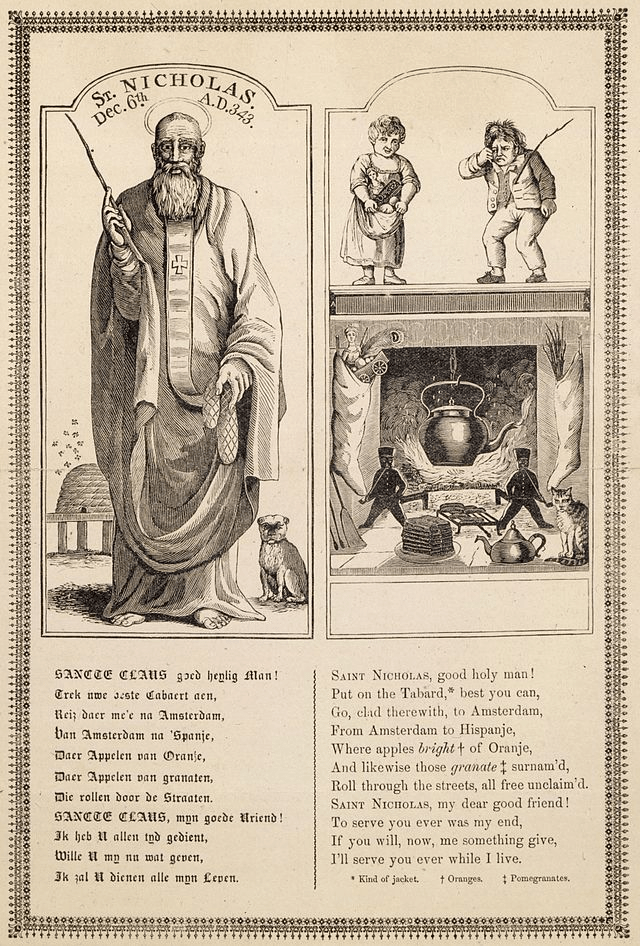
To comfort his children, the next year Pintard commissioned a broadside of St. Nicholas, who he pictured as an Episcopal bishop.  The broadside included a very large picture of the bishop, complete with halo and scepter, then in the next frame a picture of a happy, giggling girl with her apron full of presents and a sobbing, crying boy who looks as if he has just been chastised.  Beneath the picture, a poem promises Saint Nicholas, “If you will now me something give, I’ll serve you ever while I live.”

Pintard belonged to a group of New Yorkers called the Knickerbockers, which included such imminent men as Washington Irving and Clement Clarke Moore, the author of “A Visit from St. Nicholas.”  Pintard is credited with inventing Santa Claus, and Washington Irving with popularizing him.  Initially, Pintard pictured St. Nicholas as a judge, come to reward the good and punish the evil.  Nissenbaum describes Pintard’s Santa as a teaching tool for children.

To be sure, this kind of Christmas ritual was designed largely for children, while Judgment Day was for adults.  Christmas took place once a year, Judgment Day once an eternity.  The “judge” at Christmas was St. Nicholas; on Judgment Day it was God himself.  And both the rewards and the punishments meted out on Christmas – a cookie on the one hand, or a birch rod on the other – were far less weighty than those of eternal joy or eternal damnation.  But the parallel was always there, and always meant to be there.  Christmas was a child’s version of Judgment Day, and its ambiguous prospects of reward or punishment (like those of Judgment Day itself) were a means of regulating children’s behavior – and preparing them for the greater judgment that was to come.[1]

Stephen Nissenbaum, The Battle for Christmas: a Cultural History of America’s Most Cherished Holiday, p. 74
Continue reading “Jesus Beats Santa”

The Gospel Preached to the Serpent

And I will put enmity between thee and the woman, and between thy seed and her seed; it shall bruise thy head, and thou shalt bruise his heel.  

Genesis 3:15

Theologians call it the “protoevangelium”– the first gospel sermon ever preached.  After Adam and Eve sinned, when God heard the facts in the case, this was His immediate response.  God made a glorious promise, and our Christmas celebrations mark the opening act in fulfilling that promise.  As we rejoice in Christ over this Christmas celebration, we might find some bonus delights in this earliest gospel promise.  Here are a handful of points to consider.

The gospel was first announced as a curse.

When God asked Adam what he had done, Adam pointed at his wife and his wife pointed at the serpent.  Then, the Lord pronounced judgment on the serpent.

Photo by Anil Sharma on Pexels.com

And the LORD God said unto the serpent, Because thou hast done this, thou art cursed above all cattle, and above every beast of the field; upon thy belly shalt thou go, and dust shalt thou eat all the days of thy life: And I will put enmity between thee and the woman, and between thy seed and her seed; it shall bruise thy head, and thou shalt bruise his heel.  

Genesis 3:14-15

The serpent’s curse brought Adam and Eve hope.

Imagine them standing before God, trembling and ashamed for their sin, waiting for God to announce His judgment against them.  They knew God’s law:

And the LORD God commanded the man, saying, Of every tree of the garden thou mayest freely eat: But of the tree of the knowledge of good and evil, thou shalt not eat of it: for in the day that thou eatest thereof thou shalt surely die.  

Genesis 2:16-17

The criminals stood in dread, waiting for God to pronounce the death sentence.  God sentenced the serpent first, and the curse on the serpent brought hope to the other criminals.  Because the judgment on the serpent gave the first hint of a Savior for mankind.[1]  How could there be enmity between the serpent and the woman if the death sentence was immediately executed?  And how could there be a “seed” of the woman if the woman was put to death?  And how could the woman’s seed bruise the serpent’s head if the law was carried out against her?  This curse on the snake must have given Adam and Eve their first hint that God had prepared grace for them.

Here was the dawning of the gospel day.  No sooner was the wound given than the remedy was provided and revealed.[2]

God cursed Satan with the promise of a Savior.

Continue reading “The Gospel Preached to the Serpent”

An Early Christmas Offer

In our house, we start into the Christmas music a little early for some people – maybe even my wife. She would prefer we wait until Thanksgiving, while I, on the other hand, like to break out the ho-ho-ho’s shortly after Labor Day. So, like a good couple, we compromise. October 31st is Opening Day for Jingle Bells, Deck the Halls, Rudolf, and Adeste Fideles. And this year, we have something special to add to the mix. I wrote a book.

It started with my wife. Since the kids were little, we have read a Christmas devotional every night in December. We used the same devotional year after year. Then a few years ago, my wife suggested that a little variety might be in order, so we hunted around and found something different. Actually, several somethings. We read each of them in turn. Then, last year we saw a brand-new December devotional on the market, which we snatched up and put to work.

Since this Christmas tradition blessed our family, we decided to give a devotional to the members of our church. While hunting through the various options, my wife threw out a casual suggestion – as wives are wont to do: “You should write one yourself.” 

Next thing you know, I was waking up early in the morning like a man on a mission. I sat down to see if I had thirty-one ideas for devotional material. Then, I started writing. The fever hit hard. I finished most of the book in December last year, edited as a man possessed, and voila! out came this book of mine, which I boldly present to you for consideration:

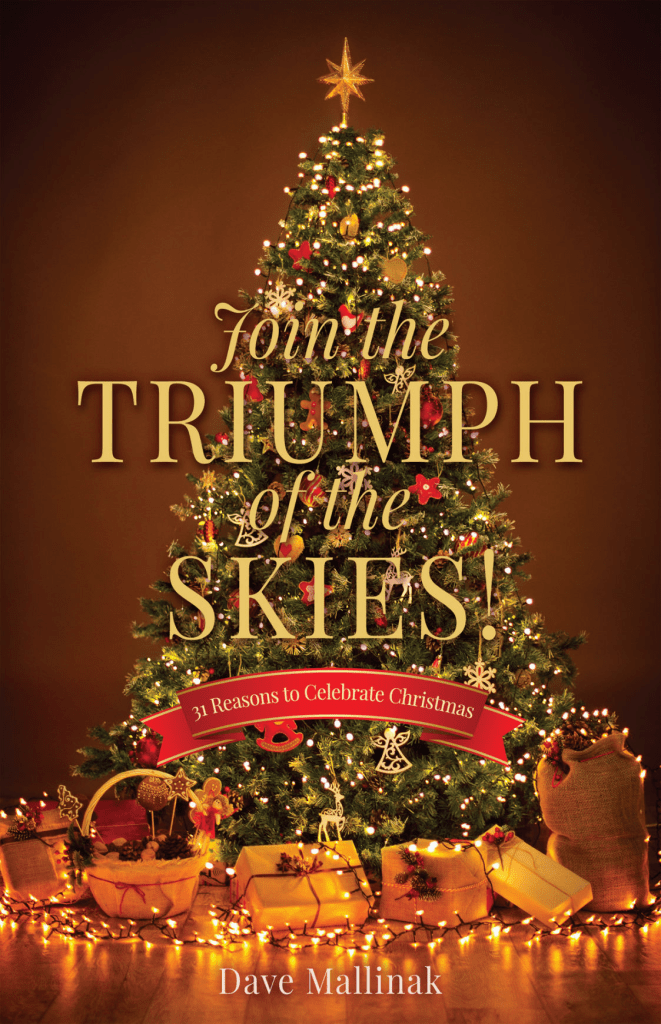
Join the Triumph of the Skies!

Christmas acts like a magnifying glass. The hard-hearted turn to Ebenezer Scrooge; family problems take on a new life; financial woes pinch harder; daily chaos turns to tumult. But Christmas offers us a fantastic opportunity to enlarge a few great things. A giving heart has rich opportunities. A generous spirit shows itself in big ways. Delight in Christ will have a feast of fat things. Family life will be richly blessed.

In our home, we always wanted Christmas to magnify what we considered vital to the good health of our home. So we planned many unique features for the Christmas season, mostly dreamed up and executed by my wife. And one of those, as I mentioned, was our annual nightly devotional routine. We had so much fun rehearsing Christ’s glory in Christmas from a Biblical perspective that we can’t wait to get started on it again this year. 

But this year, we wanted to invite you to join the fun. So we have assembled a book of 31 devotionals that cover the Christmas story’s entirety (with maybe an exception or two) – everything from angels to mangers to Bethlehem to Santa Claus to Hallmark movies to Christmas cranks to Simeon and Anna. We didn’t leave Herod out either.

Join the Triumph of the Skies! is available through our publisher at Xulon Press. It is available on Amazon and in a Kindle edition (public immediately). You can find it at Barnes and Noble, which also has an e-book edition. You could get it on Apple iBooks. And you can get it from me. If you ask real nice, I’ll give you a discount and a puppy (just kidding about the discount puppy!). Seriously, I’ll give you a deal. 

Churches and bookstores and anyone who wants to order more than five copies can contact me directly for a bonus discount. I’ll treat you right. 

So, let the buying frenzy begin. Go ahead and stuff some stockings with this book. Give it to your friends and neighbors and relatives. Give it to your local Scrooge and all the Karens on your Christmas list. Buy a case and store it in a dusty place for the next twenty years. Buy it for your good friend Holli Reath. Read it out loud at night, gathered around the Christmas tree. And may it enrich your celebration of Christ this year and many years to come.

Christ’s Joy Remaining in Me

These things have I spoken unto you, that my joy might remain in you, and that your joy might be full. (John 15:11)

Christmas was a week ago, so by now you realize that you won’t be having that classic Hallmark Christmas this year either.  Christmas can be a very miserable time, especially if you are one who thinks that Christmas will solve all your problems. Too many believe the rot that Christmas has this mystical power of reconciling family members, healing diseases, and restoring happiness.

The popularity of Hallmark movies offers nearly irrefutable proof that we love to be sentimental.  We crave that perfect Christmas joy. But if we put too much stock in the trappings and the window dressings of Christmas, we set ourselves up for a big disappointment.  So, if you are experiencing the “Christmas blues” a week after Christmas is over, you might want to consider what I am saying.

Continue reading “Christ’s Joy Remaining in Me”