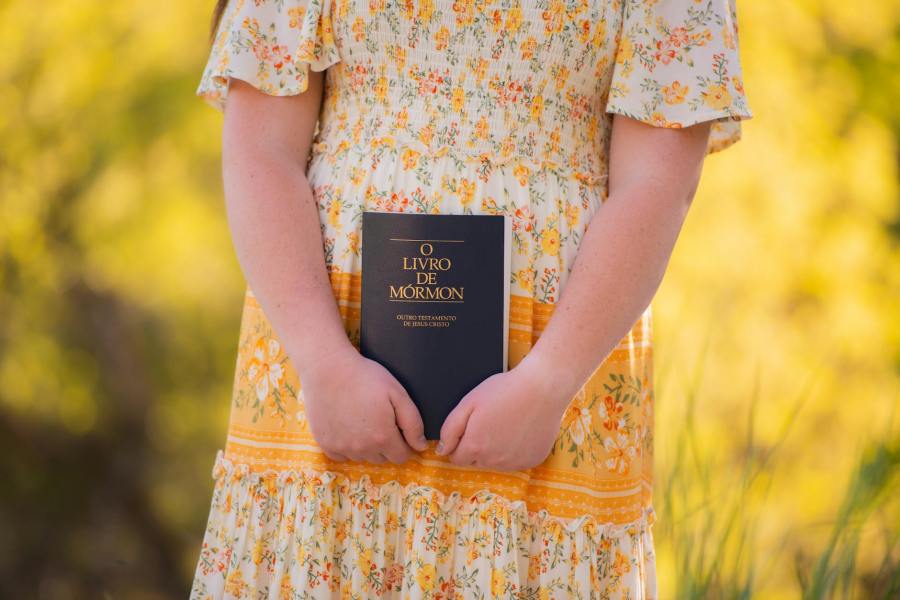
The Bible vs. the Book of Mormon: Another Challenge to my LDS Friends

The Book of Mormon is subtitled “Another Testament of Jesus Christ.” According to the Church of Jesus Christ of Latter-Day Saints website,

The Book of Mormon is a volume of holy scripture comparable to the Bible. It is a record of God’s dealings with ancient inhabitants of the Americas and contains the fulness of the everlasting gospel. [1]

Most members of the church read both the Bible and the Book of Mormon. Sunday School classes teach a three-year rotation with a year spent studying the Old Testament, the New Testament, and the Book of Mormon.* So, the three are familiar enough to you, and you probably see many similarities between them.

You probably won’t be surprised to hear that when I read the Book of Mormon, I don’t recognize the same voice, the same message, or any more than a superficial comparison between the Bible and the Book of Mormon. I understand that might offend you, but I hope you will at least consider my perspective. You might find it helpful, at least, to know why orthodox Christians like me cannot accept the Book of Mormon as Scripture.

I want to offer the following points of contrast: the Bible and the Book of Mormon don’t have comparable sources, don’t have a comparable theme, don’t have a comparable writing style, the prophetic voice is not comparable, the moral standing is not comparable, and the glory that shines from the Book of Mormon does not compare to the glory that shines forth from the Bible.

Continue reading “The Bible vs. the Book of Mormon: Another Challenge to my LDS Friends”

Subjective Truth vs Objective Truth: Some Thoughts for the LDS

One of the most attractive features of the LDS church is the encouragement members get to pursue revelations. In the early days of the church, this might have been its most popular custom. However, after a short time with this arrangement, Joseph Smith recognized its dangers.

In September 1830 Joseph and Emma Smith moved from Harmony, Pennsylvania, to Fayette, New York. When they arrived, they found that some Saints were being deceived by claims of false revelations: “To our great grief, … we soon found that Satan had been lying in wait to deceive, and seeking whom he might devour. [1]

In response, Smith received a revelation that placed a limit on the revelations that might be received by members of the church.

But, behold, verily, verily, I say unto thee, no one shall be appointed to receive commandments and revelations in this church excepting my servant Joseph Smith, Jun., for he receiveth them even as Moses. And thou shalt be obedient unto the things which I shall give unto him, even as Aaron, to declare faithfully the commandments and the revelations, with power and authority unto the church. [2] (D&C 8:2-3)

The church still encourages revelations. In fact, the church insists that if you haven’t received a revelation, you haven’t received the Holy Ghost. As Harold B. Lee taught,

Any Latter-day Saint who has been baptized and who has had hands laid upon him from those officiating, commanding him to receive the Holy Ghost, and who has not received a revelation of the spirit of the Holy Ghost, has not received the gift of the Holy Ghost to which he is entitled. [3]

But these revelations are subject to the teachings of the church. As Elder Gerald N. Lund insisted in a 1997 devotional address at BYU,

Revelation from God does not contradict gospel principles or go contrary to established Church policy and procedure.

When there is new doctrine or new procedures to come forth, you will get it in one of three ways:

a. A formal press conference will be called by the leaders of the Church, at which an official announcement will be made.

b. It will be announced through the Church News, the Ensign, or other official Church communications.

c. It will be announced in general conference by those in authority.

Otherwise, we should be very wary about accepting it, and we should not share it with others. [4]

Over many years of life and ministry in Utah, I have heard many accounts of personal revelations. One man told me about personal conversations with George Washington and Ben Franklin. Politicians tell voters they received a direct impulse from the Spirit that led them to run for office. John Hyrum Koyle received a visit from the Angel Moroni. According to Koyle’s account,

the messenger showed him in vision a massive depository of gold ore in the hills near his home. He was also told that the mine would produce financial relief, in the form of gold coins, after a future economic collapse. The sacred treasure would benefit the people by keeping alive the local economy during the financial crisis and other devastating calamities. [5]

Thus, Koyle founded a mining operation and established the Dream Mine. Other members of the church (such as the Lafferty brothers and Brian David Mitchell) have had revelations that led them to commit heinous crimes. Thankfully, this kind of “revelation” is not common among the members of the church.

Continue reading “Subjective Truth vs Objective Truth: Some Thoughts for the LDS”

LDS Friend, Please Watch This…

Through the years, I have been privileged to develop some really good friendships with Utahns who also belong to the Church of Jesus Christ of Latter Day Saints.  Recently, I watched the video shared at the bottom of this post, and I could not help but think of every one of you.  I want to make a simple request: would you watch this young man’s testimony?

By his testimony, Micah Wilder found the truth when he read the Bible as a child.  What does it mean to “read the Bible like a child?”  Instead of looking at it for confirmation of what you have always believed, read it as if it is your Father writing to you, telling you what He wants you to know about Himself, and what He has done for you.

Since coming to Utah more than 20 years ago, it has been our longing prayer that more of our fellow Utahns would come to know the peace and rest promised in Scripture, that you would be free from the pressure-cooker of performance-based religion and be able to rest completely in Jesus Christ.  This young man found something.  That is clear from what he says.  He found something that he wasn’t looking for and didn’t want.  He wasn’t searching, he wasn’t troubled, he wasn’t hiding any dark secrets or living a double life.  He lived out his religion with a great deal of zeal, but as he says, it was not according to knowledge.  His message is worth considering.  As your friend, I hope you will consider it.

A Note to My LDS Friends about the Trinity

Dear Friend,

Over the past 21 years of ministry in Utah, I have enjoyed the robust discussion we have on issues surrounding doctrine and the church. More than a few of you have made the attempt to “convert” me, and in fairness, I have not been coy about my desire to see you converted either. So what I am about to say comes out of the numerous conversations about God and the Bible we have had in my living room, in my office, or at a restaurant.

It seems to me that you believe the doctrine of the Trinity to be my Achilles’ heel. You might even believe the Trinity to be the strongest argument against orthodox Christianity. I will admit that I am relying more on anecdotal experience than hard evidence or statistics, but every time a Mormon friend – and over the years I have been blessed to make many friends here in Utah – attempts to convert me, the Trinity is always the starting point of the conversation.

Let me just say that I think I understand why you want to start there. The doctrine of the Trinity is absolutely the most difficult of all the doctrines of orthodox Christianity. You have probably noticed that even those who claim to believe in the Trinity struggle to explain exactly what they believe about the Trinity. I will not deny that the doctrine is difficult or even counterintuitive – you might think it untenable. And along with that, you probably recognize that the doctrine of the Trinity is the sine qua non of the Christian faith, the point on which all other points depend. Unless we know Who God is, we have nothing.

As a friend, I want to offer two things in this short epistle. First, I want to give you a brief sketch of the orthodox doctrine of the Trinity held by the historic Christian faith. This doctrine, by the way, was held long before Nicea. The word Trinity itself is found more than 100 times in the writings of the ante-Nicean fathers who date all the way back to Continue reading “A Note to My LDS Friends about the Trinity”