I and my Father are one. Then the Jews took up stones again to stone him. Jesus answered them, Many good works have I shewed you from my Father; for which of those works do ye stone me? The Jews answered him, saying, For a good work we stone thee not; but for blasphemy; and because that thou, being a man, makest thyself God. Jesus answered them, Is it not written in your law, I said, Ye are gods? If he called them gods, unto whom the word of God came, and the scripture cannot be broken; Say ye of him, whom the Father hath sanctified, and sent into the world, Thou blasphemest; because I said, I am the Son of God? (John 10:30-36)
The Jewish authorities taunted Jesus: “How long dost thou make us to doubt? If thou be the Christ, tell us plainly” (John 10:24). The Greek word rendered “said” in that verse uses the imperfect tense, which means they surrounded him (“then came the Jews round about him”) and kept on asking Jesus to tell them plainly. The wording in the Greek is literally, “How long do you steal away our hearts/hold up our soul?” as if Jesus were teasing them by not telling them who He really was. You see the mocking scorn in this question. They mean to taunt Jesus: “We really want to follow you, but we need to know if you really are the Messiah or not. How long will you hold us in suspense?” They use the 1st-class conditional. Literally, “Since you are the Christ, tell us plainly.” And since they asked, Jesus answered. Do you want to know Who I am? “I and my Father are one.”
Having lived and served in Utah for nearly three decades, I believe this answer and the subsequent explanation have led to some interesting obfuscations and exclamations among LDS church members. On the one hand, the more devout members twist themselves into knots in their attempt to explain away Christ’s claim in verse 30 – “I and my Father are one.” “One in purpose!” they claim as if it were possible for a lesser being than God to be one in purpose with God. But then, when we come to verses 34 and 35, they insist on the most literal interpretation possible: “See! Jesus even said that we are gods.”
Verily, verily, I say unto you, He that entereth not by the door into the sheepfold, but climbeth up some other way, the same is a thief and a robber. But he that entereth in by the door is the shepherd of the sheep. (John 10:1-2)
Jesus demonstrated His authority, not through unverifiable claims, but by mighty words and works. So, when Jesus healed a man born blind (John 9), the Pharisees knew they had a PR nightmare on their hands. They persistently refused to believe that Jesus was the Messiah (John 9:24, 29). That’s why, after the blind man was healed, the Pharisees did everything in their power to deny that he had been born blind at all or that Jesus had healed him. Rather than rejoice that the man was healed, they grilled him, insulted him, and excommunicated him.
Which is why John 10 opens with “verily, verily.” Jesus is all business. He means to point out the thieves and robbers. The Pharisees don’t care about the sheep; they only care about themselves (e.g., Luke 11:53). But Jesus cares for His sheep. Soon, the crowd will see Jesus dying and remember that the good shepherd gives his life for the sheep.
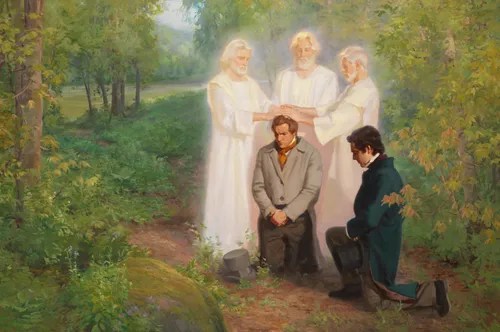
Joseph Smith claimed that God ordained him to “restore” the church. He describes the need for this “restoration” in his first vision, where he said,
My object in going to inquire of the Lord was to know which of all the sects was right, that I might know which to join. No sooner, therefore, did I get possession of myself, so as to be able to speak, than I asked the Personages who stood above me in the light, which of all the sects was right (for at this time it had never entered into my heart that all were wrong)—and which I should join.
I was answered that I must join none of them, for they were all wrong; and the Personage who addressed me said that all their creeds were an abomination in his sight; that those professors were all corrupt; that: “they draw near to me with their lips, but their hearts are far from me, they teach for doctrines the commandments of men, having a form of godliness, but they deny the power thereof.”
He again forbade me to join with any of them; and many other things did he say unto me, which I cannot write at this time.[1]
This raises some key questions that must be answered. What exactly is the great apostasy? What did the church lose that needed to be restored? What is the church, for that matter? The answers to these questions are the hinges upon which the door of truth swings concerning the claims of the first vision. This issue is so vital that in the preface to the 1993 printing of The Great Apostasy by Elder James Talmage, the publishers stated,
Occasionally, a member of the Church of Jesus Christ of Latter-day Saints will express belief in the Trinity, which typically means he believes in the Father, Son, and Holy Spirit.[1] However, it’s rare for a member to embrace the doctrine as expressed in the orthodox confessions, which they have been taught are an abomination. Many LDS church members view the doctrine of the Trinity as the Achille’s heel of orthodox Christianity. This perception stems from its challenging and seemingly illogical nature, the discomfort many Christians experience when discussing it, and the inability many have to give satisfactory answers to common objections raised against it.
How can the Father be the Son? If the Father and Son are one, why does the Son pray to the Father? Some believers have made the issue more confusing with their explanations. We have probably all heard the egg being used to illustrate the Trinity since an egg has a shell, white, and yolk but is one egg. If you have heard that illustration, you may have noticed that it proves the opposite in reality. Nobody would argue that the egg yolk is the shell, the egg white is the yolk, or the shell is the whole egg.
It matters who God is. The God of the Bible doesn’t gloss over this. In fact, He makes a specific demand: “Thou shalt have no other gods before me.” [2] That makes us responsible for knowing which God is the true God and for worshipping Him alone. Jesus taught us that the first commandment goes beyond knowing “who” or even knowing “about” God. We don’t fulfill the first commandment unless we love God with all our heart, soul, strength, and mind. We must know the God who reveals Himself in the Bible and love that God with all our being.
The God who speaks in the sixty-six books of the Old and New Testaments is the one true God. You might agree with that. But who is He? What is His nature? What kind of being is He? We want to know and believe what He tells us about Himself. This will be the subject of this essay.
“Heavenly Father,” as he is called in the LDS church, is nothing like the God who makes Himself known in the Bible. Despite the struggles Christians may have with explaining or understanding the doctrine of the Trinity, the God of the Bible is a Triune God. But the differences between the God of the Bible and Heavenly Father are far more extensive than this “novel” doctrine. To demonstrate this, we must consider some key differences between the Triune God and Heavenly Father.
Before delving into this topic, I do have a point of agreement with the Church of Jesus Christ of Latter-day Saints. We agree that God’s church is built on the foundation of the apostles and prophets, Jesus Christ being the chief cornerstone. Paul takes it a step further. “For other foundation can no man lay than that which is laid, which is Jesus Christ.” [1]
But our agreement has to end there. Paul’s description of the foundation of the New Testament church neither indicates nor requires a perpetual, unbroken quorum of apostles since its founding. The fact that the LDS church has maintained a quorum of apostles in no way lends any credence to the claim that Joseph Smith restored the true church to the earth. You can call a dog’s tail a leg, but that doesn’t mean the dog has five legs.
After more than 20 years of ministry in Utah, I’ve lost track of how often I have been asked whether I believe in living prophets or if our church has apostles. These are sham questions, juicy red herrings designed to occupy the hounds while the hunters kick back at the manor house. A living prophet and a quorum of apostles don’t make the case for a “restored” church. As the foundation of the prophets and apostles has already been laid and the cornerstone is set, there is no need to lay that foundation perpetually. Joseph Smith’s attempt to lay another foundation proves that Mormonism is a radical departure from orthodox Christianity.
Believers often say something like this: “Jesus died for our sins,” or, “Jesus died for us.” Perhaps an explanation would be helpful. The word “for” is the key. That word appears frequently in the Bible’s description of Jesus’s saving work.
God made the first gospel promise in Genesis 3, immediately after Adam and Eve ate the forbidden fruit.
And I will put enmity between thee and the woman, and between thy seed and her seed; it shall bruise thy head, and thou shalt bruise his heel.
The Old Testament points to the gospel as the focal point of all history. Paul tells us that God preached the gospel to Abraham in a unique and (seemingly) unrelated promise:
Now the LORD had said unto Abram, Get thee out of thy country, and from thy kindred, and from thy father’s house, unto a land that I will shew thee: And I will make of thee a great nation, and I will bless thee, and make thy name great; and thou shalt be a blessing: And I will bless them that bless thee, and curse him that curseth thee: and in thee shall all families of the earth be blessed. (Genesis 12:1-3)
We don’t think of this as a gospel promise, but Paul assures us it is.
And the scripture, foreseeing that God would justify the heathen through faith, preached before the gospel unto Abraham, saying, In thee shall all nations be blessed. (Galatians 3:8)
That doesn’t sound like a gospel message to our trivia-trained ears. Years of gospel cliché and platitude-preaching have conditioned us to think of the gospel as a set of doctrines or principles rather than a historical event. So, we are surprised that the first gospel promise assured two sinners that the serpent’s head would be bruised and that the gospel to Abraham promised all families of the earth a blessing in Abraham.
The whole point of the Bible is to point, present, and proclaim the gospel. Paul called it “the power of God to salvation to every one that believeth.” The four gospels give its history. The Book of Acts describes its reception. The remainder of the New Testament sets forth all its effects and blessings. The gospel dominates the entire Word of God. But what is the gospel?
The Prophet Joseph Smith said, “The first principles and ordinances of the Gospel are: first, Faith in the Lord Jesus Christ; second, Repentance; third, Baptism by immersion for the remission of sins; fourth, Laying on of hands for the gift of the Holy Ghost.”
In its fulness, the gospel includes all the doctrine, principles, laws, ordinances, and covenants necessary for us to be exalted in the celestial kingdom. The Savior has promised that if we endure to the end, faithfully living the gospel, He will hold us guiltless before the Father at the Final Judgment.
According to Joseph Smith, the driving reason for establishing the church was to “restore the gospel,” which Joseph Smith equates with restoring the church.
The “Restoration of the gospel” refers to Jesus Christ restoring the fulness of His gospel, priesthood authority, and the organization of His Church to the earth through the Prophet Joseph Smith and later prophets. [1]
The church website section on “gospel topics” outlines six different meanings of the word “salvation.”
Salvation from physical death.
Salvation from sin.
Being born again.
Salvation from ignorance.
Salvation from the second death.
Eternal life, or exaltation.
Describing these six meanings helps establish the church’s core teaching on the plan of salvation. The key features of this plan of salvation (also called the “plan of happiness”) include a few essential points.
Universal salvation.
All people eventually die. But through the Atonement and Resurrection of Jesus Christ, all people will be resurrected—saved from physical death.
Conditional salvation, dependent on the Church of Jesus Christ of Latter-Day Saints.
Those who have been baptized and have received the Holy Ghost through the proper priesthood authority have been conditionally saved from sin. In this sense, salvation is conditional, depending on an individual’s continuing in faithfulness, or enduring to the end in keeping the commandments of God (see 2 Peter 2:20–22).
Performance-based salvation, conditioned on obedience.
Individuals cannot be saved in their sins; they cannot receive unconditional salvation simply by declaring a belief in Christ with the understanding that they will inevitably commit sins throughout the rest of their lives (see Alma 11:36–37). However, through the grace of God, all can be saved from their sins (see 2 Nephi 25:23; Helaman 5:10–11) as they repent and follow Jesus Christ.
The new birth, conditioned on covenant-keeping and faithfulness.
This rebirth occurs as individuals are baptized and receive the gift of the Holy Ghost. It comes as a result of a willingness “to enter into a covenant with our God to do his will, and to be obedient to his commandments in all things that he shall command us, all the remainder of our days” (Mosiah 5:5). Through this process, their “hearts are changed through faith on his name; therefore, [they] are born of him” (Mosiah 5:7). All who have truly repented, been baptized, have received the gift of the Holy Ghost, have made the covenant to take upon themselves the name of Jesus Christ, and have felt His influence in their lives, can say that they have been born again. That rebirth can be renewed each Sabbath when they partake of the sacrament.
Enlightenment achieved by embracing the “restored” gospel.
Many people live in a state of darkness, not knowing the light of the restored gospel. They are “only kept from the truth because they know not where to find it” (Doctrine and Covenants 123:12). Those who have a knowledge of God the Father, Jesus Christ, the purpose of life, the plan of salvation, and their eternal potential are saved from this condition.
“Outer darkness” as a very limited possibility for the “sons of perdition” alone.
This second death will not come until the Final Judgment, and it will come to only a few (see Doctrine and Covenants 76:31–37). Almost every person who has ever lived on the earth is assured salvation from the second death (see Doctrine and Covenants 76:40–45).
Thus saith the Lord concerning all those who know my power, and have been made partakers thereof, and suffered themselves through the power of the devil to be overcome, and to deny the truth and defy my power – They are they who are the sons of perdition, of whom I say that it had been better for them never to have been born; For they are vessels of wrath, doomed to suffer the wrath of God, with the devil and his angels in eternity; Concerning whom I have said there is no forgiveness in this world nor in the world to come – Having denied the Holy Spirit after having received it, and having denied the Only Begotten Son of the Father, having crucified him unto themselves and put him to an open shame. These are they who shall go away into the lake of fire and brimstone, with the devil and his angels – And the only ones on whom the second death shall have any power; (Doctrines and Covenants 76:31-37)
Exaltation (or “eternal life”) achieved by a high level of performance in the church.
Eternal life is to know Heavenly Father and Jesus Christ and dwell with Them forever—to inherit a place in the highest degree of the celestial kingdom (see John 17:3; Doctrine and Covenants 131:1–4; 132:21–24). This exaltation requires that men receive the Melchizedek Priesthood, and that all Church members make and keep sacred covenants in the temple, including the covenant of eternal marriage.
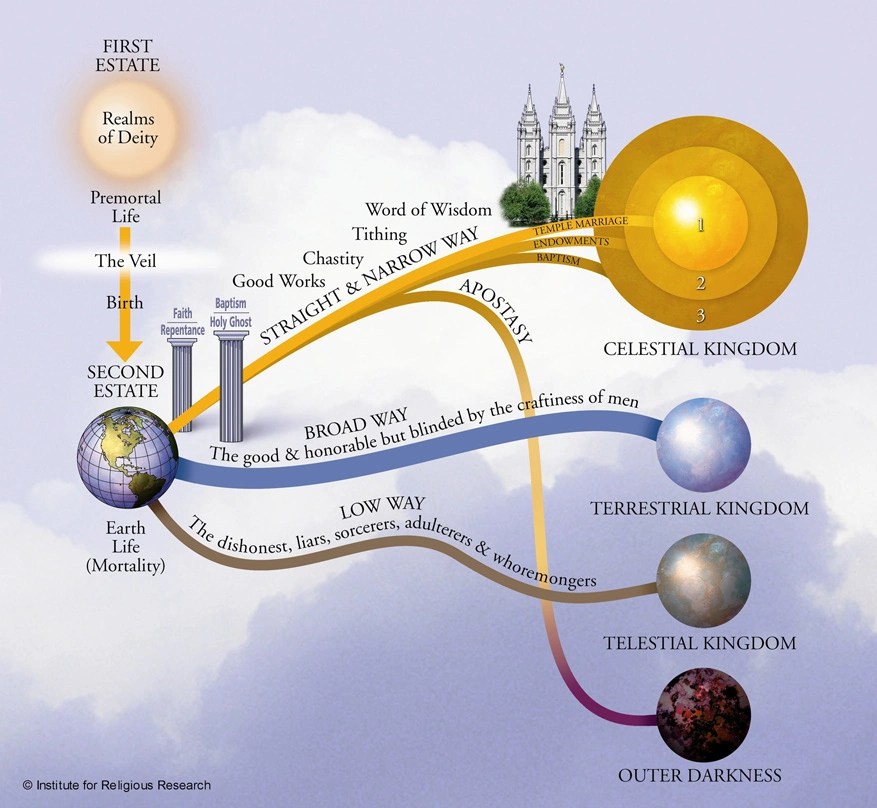
As I understand the church’s teaching, the “plan of salvation” begins when a pre-existent or premortal spirit chooses to take a body and passes through the “veil of forgetfulness.” Mortal life is a test to see whether or not a person will be faithful and obedient. After death, all enter the spirit world, either in paradise or spirit prison. Because of the atonement, all will be in the resurrection. From there, our choices before the resurrection will determine our final destination. Those who did not go the “straight and narrow way” through faith, repentance, baptism, and the Holy Ghost would spend eternity in the Terrestrial kingdom if they went the “broad way” or the Telestial kingdom if they went the “low way.” Those who went the “straight and narrow way” will be in the Celestial kingdom. Those who were on the straight and narrow way but later apostatized are the only ones who will be cast into outer darkness. The following chart nicely outlines the “plan of salvation” taught by the Mormon church (Thanks to this website).
A Biblical Response
Despite the claim that Joseph Smith “restored” the gospel, one would be hard-pressed to find any resemblance. The “restored” gospel is like the true gospel the way a cabbage is like a head, the way a Tonka truck is like a dump truck, the way a kid’s bike is like a chopper. You have the form but not the function. Joseph Smith’s “restored” gospel is not the gospel.
The claim that men removed his teachings from the Bible is ludicrous, though very convenient. You won’t find the “gospel” he taught in any part of the Bible or in any record of the historic Christian church. Joseph Smith’s plan of salvation offers no hope to escape the wrath of God against our sins, no possibility of reconciliation with God the Father, nothing but eternal damnation in the lake of fire.
First, Joseph Smith’s plan of salvation rests entirely in the Church of Jesus Christ of Latter-Day Saints. “Proper priesthood authority,” the “restored gospel,” “the Melchizedek priesthood,” covenants, and Temple work are necessary elements, and all of these are vested in the LDS church. So, the Mormon gospel does not rest on Jesus Christ’s death, burial, and resurrection for anything more than “general salvation,” which (it claims) is universal, because “all will be in the resurrection.” According to Smith, the central event in all of history and the central reason Jesus entered our world amounts to little more than a token opportunity to participate in the afterlife. Jesus is like a free admission ticket to the County Fair. If you want to do anything at the Fair, you’ll need to pay for it yourself.
Second, this plan of salvation is performance-based. “Salvation is conditional, depending on an individual’s continuing in faithfulness, or enduring to the end in keeping the commandments of God.” “However, through the grace of God, all can be saved from their sins (see 2 Nephi 25:23; Helaman 5:10–11) as they repent and follow Jesus Christ.” And 2 Nephi 25:23 (referenced above) teaches that “it is by grace that we are saved, after all we can do.” “We believe that through the Atonement of Christ, all mankind may be saved, by obedience to the laws and ordinances of the Gospel.” [2] “All who have truly repented, been baptized, have received the gift of the Holy Ghost, have made the covenant to take upon themselves the name of Jesus Christ, and have felt His influence in their lives, can say that they have been born again.” “This exaltation requires that men receive the Melchizedek Priesthood, and that all Church members make and keep sacred covenants in the temple, including the covenant of eternal marriage.” All of these things are performance-based. None of these things rely on the work of Christ. Grace provides the extra filler to cover the flaws, but nobody needs to rely on God’s grace in the gospel to save their soul. No wonder the Mormon church has created such a performance pressure cooker – when your eternal state depends so much on checking all the boxes.
Third, Jesus Christ plays no part in the Mormon plan of salvation. His death, burial, resurrection, and ascension, His broken body and shed blood, and the work God sent Him to do, have no part in the Mormon plan of salvation. Go ahead and look at ANY LDS materials you have available and see how the church describes this plan of salvation. You will find plenty of references to Jesus and be told that you must believe in Him, have faith in Him, and follow Him. But this plan of salvation depends on you and the work you do. You won’t find a description of Christ’s vicarious atonement. You won’t find any reference to His work in bearing our sins and the wrath of God for those sins. You won’t find any mention of His precious blood, which satisfies God’s righteous demands for justice. You won’t see any mention of the blood of Christ cleansing you from your sins. You won’t read about God’s work in justifying sinners, pronouncing a legal declaration from the bench, declaring that you are acquitted of all your sins. You won’t read of any such thing.
Fourth, this is an impossible gospel. Any “gospel” that depends on a human institution (the LDS church) led by fallible men with ever-shifting and sometimes contradictory explanations, any “gospel” that relies on the performance of all of its ordinances and laws and covenants in order to be achieved, is impossible. I think you feel the stress of it, the impossibility of it. Even if your church approves of your effort (as indicated by the “Temple recommend”), I think you know that your performance falls woefully short of the mark. I don’t criticize you for feeling inadequate in this. That feeling just might be the spur that drives you to Christ.
Wherefore the law was our schoolmaster to bring us unto Christ, that we might be justified by faith. (Galatians 3:24)
A Contrast of “Gospels”
Joseph Smith in no way “restored” anything to the gospel. He added to it and, in doing so, perverted and corrupted it. His “plan of salvation” is no gospel at all. Rather, Paul’s curse, twice emphasized, falls on him immediately and directly.
I marvel that ye are so soon removed from him that called you into the grace of Christ unto another gospel: Which is not another; but there be some that trouble you, and would pervert the gospel of Christ. But though we, or an angel from heaven, preach any other gospel unto you than that which we have preached unto you, let him be accursed. As we said before, so say I now again, If any man preach any other gospel unto you than that ye have received, let him be accursed. (Galatians 1:6-9)
The gospel does not consist of doctrines, ordinances, or principles to believe or follow. The gospel is an event that happened. Paul details that event in I Corinthians 15, which gives the most direct explanation of the gospel in the Bible. The word gospel means “good news.” And that good news is more than information. It is a historical event which took place at the cross.
Moreover, brethren, I declare unto you the gospel which I preached unto you, which also ye have received, and wherein ye stand; By which also ye are saved, if ye keep in memory what I preached unto you, unless ye have believed in vain. For I delivered unto you first of all that which I also received, how that Christ died for our sins according to the scriptures; And that he was buried, and that he rose again the third day according to the scriptures: (I Corinthians 15:1-4)
The gospel is not a map of our lives, traced from the spirit world before birth to our final destination in one of the kingdoms (or in outer darkness). The gospel isn’t what we do.The gospel is what Jesus did. Jesus entered our world. That isn’t a platitude; it is a historic event. His feet walked on the same earth we walk. His birth and life and death are chronicled in the gospel accounts of Matthew, Mark, Luke, and John. He went about doing good. He did no sin, neither was guile found in his mouth (I Peter 2:22). He laid down His life for the sheep (John 10:15, 17-18). He died for our sins. He bore God’s wrath against them (Isaiah 53:4-6, 10-11). He is the propitiation for our sins (Romans 3:24-26; I John 2:2, 4:10). His bloody sacrifice satisfied God’s demands for justice against our sin so that God would lay aside His wrath and extend us a pardon. All of this was done by the work of Jesus; none of it by us. The sin was ours, the guilt was ours, the desperate need was ours, and the saving work was His, from start to finish, from beginning to end. The gospel is the climax of His life, and of all history.
“According to Christian belief, Jesus is our Savior, not by virtue of what He said, not even by virtue of what He was, but by what He did. He is our Savior, not because He has inspired us to live the same kind of life that He lived, but because He took upon Himself the dreadful guilt of our sins and bore it instead of us on the cross. Such is the Christian conception of the Cross of Christ.” (J. Gresham Machen)
The Bible is God speaking to man, making His will known. The best demonstration of this fact comes in the introduction to the 10 commandments, where the Bible says,
And God spake all these words, saying, I am the LORD thy God, which have brought thee out of the land of Egypt, out of the house of bondage. (Exodus 20:1-2)
The moral authority of the Decalogue grows out of the claim that “I am the LORD thy God.” Everything that follows – “Thou shalt have no other gods before me,” “Thou shalt not make unto thee any graven image,” “Thou shalt not take the name of the LORD thy God in vain,” “Remember the sabbath day, to keep it holy,” “Honour thy father and thy mother,” “Thou shalt not kill,” “Thou shalt not commit adultery,” “Thou shalt not steal,” “Thou shalt not bear false witness,” “Thou shalt not covet,” are all binding on the conscience because “the LORD thy God” commanded them.
The Bible’s moral authority is always clear and expressed. The prophets declare it repeatedly: “Thus saith the Lord,” appears in 413 verses of the Old Testament (348 times in the prophets). Prophets didn’t draw moral authority from a vision they had. They declared the Word of God. Everywhere in Scripture, this moral authority is proclaimed as central to the authority of Scripture. The men of the Bible don’t attempt to bind the conscience with their own experiences of visions. They boldly declared the words of God.
From start to finish, God’s presence and glory are the Bible’s central focus. The book of Revelation (which is “the revelation of Jesus Christ”) ends with praise for God. “The grace of our Lord Jesus Christ be with you all. Amen” (Revelation 22:21). The opening lines of Scripture – “In the beginning God created the heaven and the earth.” – make it abundantly clear that the Bible isn’t a book about men, it is a book about God. The Bible isn’t the word of men; it is the word of God. All the writings of Scripture are God-breathed (2 Timothy 3:16). Though the Bible tells the stories of many famous men and heroes of the faith like Noah and Abraham and David and Isaiah and Daniel, yet the Bible isn’t about those men. Their stories tell us about God. When we read their stories, we learn what God did.
God’s claims on man are proclaimed repeatedly in every book of the Bible. God sets forth His authority as the moral foundation of all of Scripture. Satan challenged that authority: “Hath God said.” Adam and Eve sinned against that authority. Noah prepared an ark to the saving of his house at that authority. Abraham was called by God. David was anointed by God. Jesus Himself was sent by God, anointed by God, and saved the world through His perfect obedience to His Father.
Jesus came to bear witness to the truth (John 18:37); He is the truth (John 14:6); His Word is truth (John 17:17); His truth sets us free (John 8:32). Jesus declares God to us and is the clearest expression of God.
For God, who commanded the light to shine out of darkness, hath shined in our hearts, to give the light of the knowledge of the glory of God in the face of Jesus Christ. (2 Corinthians 4:6)
Who being the brightness of his glory, and the express image of his person, and upholding all things by the word of his power, when he had by himself purged our sins, sat down on the right hand of the Majesty on high; (Hebrews 1:3)
For in him dwelleth all the fulness of the Godhead bodily. (Colossians 2:9)
God’s holy law is a beautiful thing, a glorious thing. The Psalmist carries us into raptures of glory in his descriptions of it.
O how love I thy law! it is my meditation all the day. (Psalm 119:97)
The law of the LORD is perfect, converting the soul: the testimony of the LORD is sure, making wise the simple. The statutes of the LORD are right, rejoicing the heart: the commandment of the LORD is pure, enlightening the eyes. The fear of the LORD is clean, enduring for ever: the judgments of the LORD are true and righteous altogether. More to be desired are they than gold, yea, than much fine gold: sweeter also than honey and the honeycomb. Moreover by them is thy servant warned: and in keeping of them there is great reward. (Psalm 19:7-11)
The holiness of God is the central feature of the Bible. All that is good in the world springs out of God as the fountainhead, and He is altogether lovely and good and gracious.
The LORD is righteous in all his ways, and holy in all his works. (Psalm 145:17)
And the heavens shall declare his righteousness: for God is judge himself. Selah. (Psalm 50:6)
Justice and judgment are the habitation of thy throne: mercy and truth shall go before thy face. (Psalm 89:14)
He is the Rock, his work is perfect: for all his ways are judgment: a God of truth and without iniquity, just and right is he. (Deuteronomy 32:4)
Any honest comparison between the Bible and the Book of Mormon will demonstrate that the Book of Mormon doesn’t have the same focus. The Genesis of the Book of Mormon – the story of Lehi and his family as narrated by Nephi – makes this abundantly clear. The Book of Mormon is a book about men, about Nephi and Lehi and Laman and their descendants. God is peripheral to the story. He shows up with visions from time to time, but the meat of the story has to do with the men who had the vision and the men who opposed those visionary men.
Consider Nephi’s introduction to the entire Book of Mormon, as recorded in I Nephi 1:1-3. In that introduction, Nephi speaks of himself primarily (he uses the 1st person pronoun 16 times in the first 3 verses and never mentions God).
I, Nephi, having been born of goodly parents, therefore I was taught somewhat in all the learning of my father; and having seen many afflictions in the course of my days, nevertheless, having been highly favored of the Lord in all my days; yea, having had a great knowledge of the goodness and the mysteries of God, therefore I make a record of my proceedings in my days.Yea, I make a record in the language of my father, which consists of the learning of the Jews and the language of the Egyptians.And I know that the record which I make is true; and I make it with mine own hand; and I make it according to my knowledge.
Nephi insists that his record is true and that he makes it “according to my knowledge” (v. 3). In the Bible, God initiates any kind of meeting with men (consider Moses and the burning bush in Exodus 3, for example). But in the case of Lehi, God doesn’t initiate anything. Nephi relates how Lehi prayed down a pillar of fire and a vision that eventually led to him seeing a book (vv. 5-11). God doesn’t speak at all in the chapter, but Nephi relates the words Lehi read in the book and the things Lehi said in response.
When God finally speaks in chapter 2, Nephi relates Lehi’s third-hand account of God’s message. God doesn’t speak directly. And most of what God says is praise for Lehi.
For behold, it came to pass that the Lord spake unto my father, yea, even in a dream, and said unto him: Blessed art thou Lehi, because of the things which thou hast done; and because thou hast been faithful and declared unto this people the things which I commanded thee, behold, they seek to take away thy life. (I Nephi 2:1)
Nor is this praise of Lehi particularly true. A few verses later (2:7), Lehi builds an altar and offers a sacrifice to the Lord. God insisted that the Tabernacle of Moses was the exclusive place for worship until that Tabernacle was replaced by Solomon’s temple (see Deuteronomy 12:1-14 and Leviticus 17:2-6). Given that Lehi built this altar in the wilderness by the Red Sea around 600 B.C., long after Solomon’s Temple was established, this was an act of blatant disobedience to the Lord he claimed to worship. From the beginning of the Book of Mormon, Lehi leads his sons to disregard God’s word. Jeremiah forbade the people from leaving Jerusalem and fleeing to Egypt during this same time (Jeremiah 42:19-20), and Lehi claims that God gave him an exclusive vision to the contrary. Lehi doesn’t at all live up to Nephi’s claim.
Nephi’s brothers, the sons of Lehi, are praised or censured based on their willingness to take Lehi’s word for things. When they reject Lehi’s visions or resist making dramatic life changes based on Lehi’s claim to have had a vision, they are painted as the villains in the story. For instance, I Nephi 2:11 says
Now this he spake because of the stiffneckedness of Laman and Lemuel; for behold they did murmur in many things against their father, because he was a visionary man, and had led them out of the land of Jerusalem, to leave the land of their inheritance, and their gold, and their silver, and their precious things, to perish in the wilderness. And this they said he had done because of the foolish imaginations of his heart.
And I Nephi 7:6-7 tells us,
And it came to pass that as we journeyed in the wilderness, behold Laman and Lemuel, and two of the daughters of Ishmael, and the two sons of Ishmael and their families, did rebel against us; yea, against me, Nephi, and Sam, and their father, Ishmael, and his wife, and his three other daughters. And it came to pass in the which rebellion, they were desirous to return unto the land of Jerusalem.
And in perhaps the most glaring example of this imposed requirement that Laman and Lemuel embrace every claim their father has to a vision, I Nephi 8 records a vision Lehi had about these two “wayward” sons, who fall further into his displeasure because, in his vision, they refused to eat the fruit he dreamed about.
And it came to pass that I was desirous that Laman and Lemuel should come and partake of the fruit also; wherefore, I cast mine eyes towards the head of the river, that perhaps I might see them. And it came to pass that I saw them, but they would not come unto me and partake of the fruit.
And Laman and Lemuel partook not of the fruit, said my father. And it came to pass after my father had spoken all the words of his dream or vision, which were many, he said unto us, because of these things which he saw in a vision, he exceedingly feared for Laman and Lemuel; yea, he feared lest they should be cast off from the presence of the Lord. And he did exhort them then with all the feeling of a tender parent, that they would hearken to his words, that perhaps the Lord would be merciful to them, and not cast them off; yea, my father did preach unto them. (I Nephi 8:17-18, 25-37)
In what might be one of the most telling examples of disregard for God’s law recorded in the Book of Mormon, Nephi leads his brothers to return to Jerusalem to demand that Laban give them the plates of brass with the family records. This story illustrates the blatant disregard for God’s law that is excused by claims of a vision. When Laban refuses to surrender the plates of brass, I Nephi 4 tells us,
And I was led by the Spirit, not knowing beforehand the things which I should do.Nevertheless I went forth, and as I came near unto the house of Laban I beheld a man, and he had fallen to the earth before me, for he was drunken with wine.And when I came to him I found that it was Laban.And I beheld his sword, and I drew it forth from the sheath thereof; and the hilt thereof was of pure gold, and the workmanship thereof was exceedingly fine, and I saw that the blade thereof was of the most precious steel.And it came to pass that I was constrained by the Spirit that I should kill Laban; but I said in my heart: Never at any time have I shed the blood of man. And I shrunk and would that I might not slay him.And the Spirit said unto me again: Behold the Lord hath delivered him into thy hands. Yea, and I also knew that he had sought to take away mine own life; yea, and he would not hearken unto the commandments of the Lord; and he also had taken away our property.And it came to pass that the Spirit said unto me again: Slay him, for the Lord hath delivered him into thy hands;Behold the Lord slayeth the wicked to bring forth his righteous purposes. It is better that one man should perish than that a nation should dwindle and perish in unbelief.And now, when I, Nephi, had heard these words, I remembered the words of the Lord which he spake unto me in the wilderness, saying that: Inasmuch as thy seed shall keep my commandments, they shall prosper in the land of promise.Yea, and I also thought that they could not keep the commandments of the Lord according to the law of Moses, save they should have the law.And I also knew that the law was engraven upon the plates of brass.And again, I knew that the Lord had delivered Laban into my hands for this cause—that I might obtain the records according to his commandments. Therefore I did obey the voice of the Spirit, and took Laban by the hair of the head, and I smote off his head with his own sword.
So, we are to believe that “righteous” Nephi was commanded to kill a man while that man is fallen down drunk and totally incapacitated – an act of cowardice and murder – because “the Spirit” told him to do that. This is what I mean in saying that the Book of Mormon has a different moral authority. Not surprisingly, adherents to Mormonism, such as Ron and Dan Lafferty, have followed Nephi’s example.
The Book of Mormon consistently claims to bind the conscience based on a private “revelation” of some sort. We find many examples of the insistence that visions and revelations must come from God, that the righteous are the ones who receive such visions, and that others in their realm of influence are morally bound to believe the ones who claim to have had visions. 2 Nephi 5 provides us with a related example to what we see in I Nephi –an extension really of Lehi’s earlier claims.
Wherefore, it came to pass that I, Nephi, did take my family, and also Zoram and his family, and Sam, mine elder brother and his family, and Jacob and Joseph, my younger brethren, and also my sisters, and all those who would go with me. And all those who would go with me were those who believed in the warnings and the revelations of God; wherefore, they did hearken unto my words.
And behold, the words of the Lord had been fulfilled unto my brethren, which he spake concerning them, that I should be their ruler and their teacher. Wherefore, I had been their ruler and their teacher, according to the commandments of the Lord, until the time they sought to take away my life.Wherefore, the word of the Lord was fulfilled which he spake unto me, saying that: Inasmuch as they will not hearken unto thy words they shall be cut off from the presence of the Lord. And behold, they were cut off from his presence.And he had caused the cursing to come upon them, yea, even a sore cursing, because of their iniquity. For behold, they had hardened their hearts against him, that they had become like unto a flint; wherefore, as they were white, and exceedingly fair and delightsome, that they might not be enticing unto my people the Lord God did cause a skin of blackness to come upon them.And thus saith the Lord God: I will cause that they shall be loathsome unto thy people, save they shall repent of their iniquities.And cursed shall be the seed of him that mixeth with their seed; for they shall be cursed even with the same cursing. And the Lord spake it, and it was done.And because of their cursing which was upon them they did become an idle people, full of mischief and subtlety, and did seek in the wilderness for beasts of prey. (2 Nephi 5: 6, 19-24)
The curse here, which is black skin, is given because the Lamanites refuse to believe Nephi’s vision. Visions in the Book of Mormon are all the rage, and those who have them, apparently, have a moral claim on everyone else. In fact, it seems that quite a few things that we are bound to believe are confirmed through visions and revelations. This would include even faith in Jesus Christ, which is not argued at all on the matchless worth or glory of Jesus Christ but on a personal revelation of His truth.
And now, my beloved brethren, and also Jew, and all ye ends of the earth, hearken unto these words and believe in Christ; and if ye believe not in these words believe in Christ. And if ye shall believe in Christ ye will believe in these words, for they are the words of Christ, and he hath given them unto me; and they teach all men that they should do good.And if they are not the words of Christ, judge ye—for Christ will show unto you, with power and great glory, that they are his words, at the last day; and you and I shall stand face to face before his bar; and ye shall know that I have been commanded of him to write these things, notwithstanding my weakness. (2 Nephi 33:10-11)
Even something as simple as right and wrong, which the Bible insists is established by God and must measure up to the standard of His holiness (e.g., Romans 7:12), is subjective in the Book of Mormon.
For behold, my brethren, it is given unto you to judge, that ye may know good from evil; and the way to judge is as plain, that ye may know with a perfect knowledge, as the daylight is from the dark night. For behold, the Spirit of Christ is given to every man, that he may know good from evil; wherefore, I show unto you the way to judge; for every thing which inviteth to do good, and to persuade to believe in Christ, is sent forth by the power and gift of Christ; wherefore ye may know with a perfect knowledge it is of God. (Moroni 7:15-16)
Clearly, the Book of Mormon itself teaches us to mediate every moral claim through visions and revelations, relying on “inner light” (Moroni 7:18-19) rather than on the perfect standard of God’s Word. This is a very different moral authority than what we find in the Bible, where God points to Himself as the authority and standard of all things. The Bible doesn’t invite us to sit in judgment of God but warns us against rejecting Him. The heavens declare His glory; He is God, and there is none else. We do not need such thin, hollow things as visions and revelations to know the truth. We need only look to Christ, “In whom are hid all the treasures of wisdom and knowledge” (Colossians 2:3).
Prophecy is central to the LDS church. From the time of Joseph Smith to the present, the title for every president of the Church of Jesus Christ of Latter-Day Saints has been “prophet, seer, and revelator.” Most members of the church believe that the word of the current prophet takes precedence over the words of former prophets. As I am told repeatedly, “That’s why we have a living prophet.”
The faith of most church members is rooted in a unique revelation that their church is the true church. These members believe their church’s departure from Biblical Christianity is justified, not because they can prove that “all Christian churches are apostate” or that Joseph Smith restored the gospel, but because they have a personal testimony that Joseph Smith is a true prophet and the Book of Mormon is another testament of Jesus Christ. This personal revelation, often described as a spiritual witness, is a cornerstone of their faith. So, the church relies on special revelation for every claim it makes, and the people depend on revelation (rather than objective reasons) for believing these special revelations. We could argue that the church hangs entirely on prophecy – the prophecies of the Book of Mormon as revealed by Joseph Smith, the living prophet, and the personal revelation received by the faithful.
The Apostle Paul gives a rule for handling prophecies and a prophetic word.
And the spirits of the prophets are subject to the prophets. (I Corinthians 14:32)
Likewise, John teaches us,
Beloved, believe not every spirit, but try the spirits whether they are of God: because many false prophets are gone out into the world. (I John 4:1)
This aligns with the noble Bereans, who “received the word with all readiness of mind, and searched the scriptures daily, whether those things were so” (Acts 17:11). The Bible, as the authoritative voice of God, serves as the litmus test for any prophetic word. All revelations must be measured against this standard. Testing prophetic words with the Bible is not just a suggestion but a necessity for maintaining the truth and ensuring that the church’s teachings agree with the divine word.
Our examination of the Book of Mormon centers on a desire to hold it up to the standard of God’s Word. We have already pointed out several contrasts between the Bible and the Book of Mormon. Here is another: the Book of Mormon doesn’t handle prophecy like the Bible. Let me demonstrate.
A Contrast of Prophetic Messages
The Book of Mormon has several notable prophecies in it. Consider this example from I Nephi 10:7-11.
When we compare the Bible to the Book of Mormon, we’re essentially contrasting a literary masterpiece like Shakespeare with a Junior High creative writing class. Both have their unique narratives, but one stands out as a masterwork. While the Book of Mormon is often touted as another testament of Jesus Christ and a scripture volume on par with the Bible, I find it challenging to draw more than a surface-level comparison between the two.



 The Village Smithy