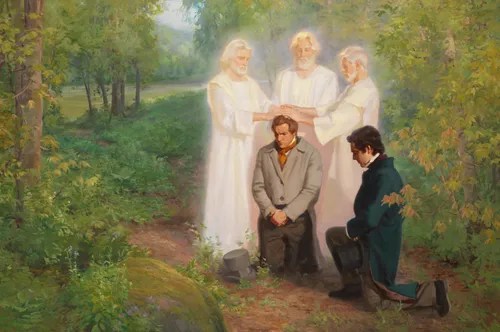
The Weight of Glory

A virtuous woman is a crown to her husband: but she that maketh ashamed is as rottenness in his bones. (Proverbs 12:4)

I heard a pastor make a silly claim some years ago. He said the husband might be the head, but the wife is the neck that turns the head.

Not only is this a craven admission on his part, but it also shows a terrible misunderstanding of the role of husband and wife. The husband needs to have a strong neck and shoulders. He bears the weight of a heavy crown, and the crown he bears is no light thing.

Continue reading “The Weight of Glory”

Fig Leaves in Our Relationships

And the eyes of them both were opened, and they knew that they were naked; and they sewed fig leaves together, and made themselves aprons. (Genesis 3:7)

Genesis tells us the beginnings of everything in our world, including our problems. And relationship problems are a prominent feature of our history, culture, and life. Adam and Eve ate the forbidden fruit. Maybe they thought they would die if they ate it, or maybe Adam thought Eve would die. Maybe Adam thought it was safe when she didn’t die, so he ate it. Then, the wheels started coming off.

The Bible describes three immediate results when Adam and Eve ate the forbidden fruit, all connected. First, their eyes were opened. Notice that the verse says, “the eyes of them both” were opened. They were told this would happen, by the way, and they seemed to want that. Remember what the serpent told them?

For God doth know that in the day ye eat thereof, then your eyes shall be opened, and ye shall be as gods, knowing good and evil. (Genesis 3:5)

They wanted to know what God had not yet revealed, and they wanted to know it independently of God. Though it doesn’t fit our discussion, we can profit from charting the relationship between the Fall and an autonomous pursuit of knowledge. But the point is that Satan didn’t lie about the result of eating the fruit. Their eyes were opened, and apparently, they knew something more about good and evil than they knew in their state of innocence.

But notice the second immediate result when they ate the forbidden fruit: they knew that they were naked. We assume (based on the third result) that they were ashamed of this nakedness because the Bible says that they sewed fig leaves together and made themselves aprons. The Bible doesn’t say anything about shame in Genesis 3, but the Bible often associates shame with nakedness, and their response is consistent with shame. Adam later confessed that he was afraid because he was naked (Genesis 3:10). We can assume that when their eyes were opened, Adam and Eve learned embarrassing things about themselves that made them want to hide from each other. Later, they hid from God, too. But the fig leaf aprons were to protect themselves from each other.

Continue reading “Fig Leaves in Our Relationships”

No More Mr. Nice Guy

But he that is married careth for the things that are of the world, how he may please his wife. (I Corinthians 7:33)

Paul points out a reality for married men. Some see this as an indictment against marriage. I think Paul means to say that this is the way it is. But it can be one of your marriage’s sneakier and more persistent problems.

You might wonder, “What could be wrong with trying to please my wife?” And I would answer that it isn’t wrong – you aren’t in sin for wanting to please her. In fact, it is natural. If you love her, treasure her, and value her, you will also want to please her. Some guys figure out what their wife wants and do the opposite. They crush, trample, despise, and disrespect her in every possible way. And obviously, that is wrong. Don’t be an alpha-jerk.

Continue reading “No More Mr. Nice Guy”

What Are We Fighting For?

This is the second preview chapter of my upcoming book of advice and counsel for young men who are about to marry.

It would be highly unusual if you managed to avoid getting into a fight or two with your wife. Maybe “fight” isn’t the best word, given this kinder, gentler age in which we live. How about a hotly contested disagreement? Hopefully, no frying pans or rolling pins will be damaged. But chances are, you’ll have a “strong disagreement” with your wife. Some might call it a dispute. Others will just say, “fight.”

One of the more considerable challenges in marriage will be learning how to handle disagreements. As you mature, you should do better. But, you will mishandle some disagreements. And in some cases, you both might feel embarrassed about how it played out. A wife once confessed to me with tears that she got so mad at her husband that she…

I probably shouldn’t finish that. Someone will think I should have turned her in. If the police had been called, she would have gone to jail. Passions can rage.

Continue reading “What Are We Fighting For?”

What About Those Love Languages?

This is a chapter from an upcoming book of advice for young men before they marry. Details about the book should be available soon.

Visit any thrift store, used book store, or (sometimes) yard sale, and you might find a copy of Gary Chapman’s book The Five Love Languages. Chapman trademarked the term, then wrote books for nearly every possible demographic. I have speculated that his publishers gave him a bonus every time he used the term “love language,” given how frequently he says it.

But enough about the annoyances. I appreciate what Chapman did with his book. He boiled down and identified some specific ways we show love to each other. His most important point, I think, is this: learn to love your wife in a way that makes her feel loved.

As men, we know what we like. We tend to think that our wife will enjoy the same thing. So, for example, if physical touch makes you feel loved, you are likely to believe that physical touch will make your wife feel loved as well. But she is different than you.

Gary Chapman hit on an important principle: you love your wife best when you find what makes her feel loved. You don’t love your wife well by loving yourself well. And when you express love in ways that make you feel loved, you are loving yourself, not her.

Continue reading “What About Those Love Languages?”

Ye Are Gods, But Not Like That

I and my Father are one. Then the Jews took up stones again to stone him. Jesus answered them, Many good works have I shewed you from my Father; for which of those works do ye stone me? The Jews answered him, saying, For a good work we stone thee not; but for blasphemy; and because that thou, being a man, makest thyself God. Jesus answered them, Is it not written in your law, I said, Ye are gods? If he called them gods, unto whom the word of God came, and the scripture cannot be broken; Say ye of him, whom the Father hath sanctified, and sent into the world, Thou blasphemest; because I said, I am the Son of God? (John 10:30-36)

The Jewish authorities taunted Jesus: “How long dost thou make us to doubt? If thou be the Christ, tell us plainly” (John 10:24). The Greek word rendered “said” in that verse uses the imperfect tense, which means they surrounded him (“then came the Jews round about him”) and kept on asking Jesus to tell them plainly. The wording in the Greek is literally, “How long do you steal away our hearts/hold up our soul?” as if Jesus were teasing them by not telling them who He really was. You see the mocking scorn in this question. They mean to taunt Jesus: “We really want to follow you, but we need to know if you really are the Messiah or not. How long will you hold us in suspense?” They use the 1st-class conditional. Literally, “Since you are the Christ, tell us plainly.” And since they asked, Jesus answered. Do you want to know Who I am? “I and my Father are one.”

Having lived and served in Utah for nearly three decades, I believe this answer and the subsequent explanation have led to some interesting obfuscations and exclamations among LDS church members. On the one hand, the more devout members twist themselves into knots in their attempt to explain away Christ’s claim in verse 30 – “I and my Father are one.” “One in purpose!” they claim as if it were possible for a lesser being than God to be one in purpose with God. But then, when we come to verses 34 and 35, they insist on the most literal interpretation possible: “See! Jesus even said that we are gods.”

Continue reading “Ye Are Gods, But Not Like That”

Joseph Smith, Hireling

Verily, verily, I say unto you, He that entereth not by the door into the sheepfold, but climbeth up some other way, the same is a thief and a robber. But he that entereth in by the door is the shepherd of the sheep. (John 10:1-2)

Jesus demonstrated His authority, not through unverifiable claims, but by mighty words and works. So, when Jesus healed a man born blind (John 9), the Pharisees knew they had a PR nightmare on their hands. They persistently refused to believe that Jesus was the Messiah (John 9:24, 29). That’s why, after the blind man was healed, the Pharisees did everything in their power to deny that he had been born blind at all or that Jesus had healed him. Rather than rejoice that the man was healed, they grilled him, insulted him, and excommunicated him.

Which is why John 10 opens with “verily, verily.” Jesus is all business. He means to point out the thieves and robbers. The Pharisees don’t care about the sheep; they only care about themselves (e.g., Luke 11:53). But Jesus cares for His sheep. Soon, the crowd will see Jesus dying and remember that the good shepherd gives his life for the sheep.

Continue reading “Joseph Smith, Hireling”

Why Joseph Smith Cannot Possibly “Restore” the Church

Joseph Smith claimed that God ordained him to “restore” the church. He describes the need for this “restoration” in his first vision, where he said,

My object in going to inquire of the Lord was to know which of all the sects was right, that I might know which to join. No sooner, therefore, did I get possession of myself, so as to be able to speak, than I asked the Personages who stood above me in the light, which of all the sects was right (for at this time it had never entered into my heart that all were wrong)—and which I should join.

 I was answered that I must join none of them, for they were all wrong; and the Personage who addressed me said that all their creeds were an abomination in his sight; that those professors were all corrupt; that: “they draw near to me with their lips, but their hearts are far from me, they teach for doctrines the commandments of men, having a form of godliness, but they deny the power thereof.”

 He again forbade me to join with any of them; and many other things did he say unto me, which I cannot write at this time.[1]

This raises some key questions that must be answered. What exactly is the great apostasy? What did the church lose that needed to be restored? What is the church, for that matter? The answers to these questions are the hinges upon which the door of truth swings concerning the claims of the first vision. This issue is so vital that in the preface to the 1993 printing of The Great Apostasy by Elder James Talmage, the publishers stated,

Continue reading “Why Joseph Smith Cannot Possibly “Restore” the Church”

The Triune God v. Heavenly Father

Occasionally, a member of the Church of Jesus Christ of Latter-day Saints will express belief in the Trinity, which typically means he believes in the Father, Son, and Holy Spirit.[1] However, it’s rare for a member to embrace the doctrine as expressed in the orthodox confessions, which they have been taught are an abomination. Many LDS church members view the doctrine of the Trinity as the Achille’s heel of orthodox Christianity. This perception stems from its challenging and seemingly illogical nature, the discomfort many Christians experience when discussing it, and the inability many have to give satisfactory answers to common objections raised against it.

How can the Father be the Son? If the Father and Son are one, why does the Son pray to the Father? Some believers have made the issue more confusing with their explanations. We have probably all heard the egg being used to illustrate the Trinity since an egg has a shell, white, and yolk but is one egg. If you have heard that illustration, you may have noticed that it proves the opposite in reality. Nobody would argue that the egg yolk is the shell, the egg white is the yolk, or the shell is the whole egg.

It matters who God is. The God of the Bible doesn’t gloss over this. In fact, He makes a specific demand: “Thou shalt have no other gods before me.” [2] That makes us responsible for knowing which God is the true God and for worshipping Him alone. Jesus taught us that the first commandment goes beyond knowing “who” or even knowing “about” God. We don’t fulfill the first commandment unless we love God with all our heart, soul, strength, and mind. We must know the God who reveals Himself in the Bible and love that God with all our being.

The God who speaks in the sixty-six books of the Old and New Testaments is the one true God. You might agree with that. But who is He? What is His nature? What kind of being is He? We want to know and believe what He tells us about Himself. This will be the subject of this essay.

“Heavenly Father,” as he is called in the LDS church, is nothing like the God who makes Himself known in the Bible. Despite the struggles Christians may have with explaining or understanding the doctrine of the Trinity, the God of the Bible is a Triune God. But the differences between the God of the Bible and Heavenly Father are far more extensive than this “novel” doctrine. To demonstrate this, we must consider some key differences between the Triune God and Heavenly Father.

Continue reading “The Triune God v. Heavenly Father”

True Apostles v False Apostles of Mormonism

Before delving into this topic, I do have a point of agreement with the Church of Jesus Christ of Latter-day Saints. We agree that God’s church is built on the foundation of the apostles and prophets, Jesus Christ being the chief cornerstone. Paul takes it a step further. “For other foundation can no man lay than that which is laid, which is Jesus Christ.” [1]

But our agreement has to end there. Paul’s description of the foundation of the New Testament church neither indicates nor requires a perpetual, unbroken quorum of apostles since its founding. The fact that the LDS church has maintained a quorum of apostles in no way lends any credence to the claim that Joseph Smith restored the true church to the earth. You can call a dog’s tail a leg, but that doesn’t mean the dog has five legs.  

After more than 20 years of ministry in Utah, I’ve lost track of how often I have been asked whether I believe in living prophets or if our church has apostles. These are sham questions, juicy red herrings designed to occupy the hounds while the hunters kick back at the manor house. A living prophet and a quorum of apostles don’t make the case for a “restored” church. As the foundation of the prophets and apostles has already been laid and the cornerstone is set, there is no need to lay that foundation perpetually. Joseph Smith’s attempt to lay another foundation proves that Mormonism is a radical departure from orthodox Christianity.

Continue reading “True Apostles v False Apostles of Mormonism”