
Before delving into this topic, I do have a point of agreement with the Church of Jesus Christ of Latter-day Saints. We agree that God’s church is built on the foundation of the apostles and prophets, Jesus Christ being the chief cornerstone. Paul takes it a step further. “For other foundation can no man lay than that which is laid, which is Jesus Christ.” [1]
But our agreement has to end there. Paul’s description of the foundation of the New Testament church neither indicates nor requires a perpetual, unbroken quorum of apostles since its founding. The fact that the LDS church has maintained a quorum of apostles in no way lends any credence to the claim that Joseph Smith restored the true church to the earth. You can call a dog’s tail a leg, but that doesn’t mean the dog has five legs.
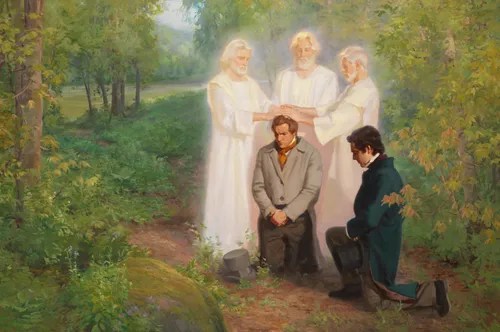
After more than 20 years of ministry in Utah, I’ve lost track of how often I have been asked whether I believe in living prophets or if our church has apostles. These are sham questions, juicy red herrings designed to occupy the hounds while the hunters kick back at the manor house. A living prophet and a quorum of apostles don’t make the case for a “restored” church. As the foundation of the prophets and apostles has already been laid and the cornerstone is set, there is no need to lay that foundation perpetually. Joseph Smith’s attempt to lay another foundation proves that Mormonism is a radical departure from orthodox Christianity.
Nevertheless, many in the LDS church are convinced that the presence of a living prophet and a quorum of twelve apostles confirms that their church is the only true church. When asked, “What do we mean when we say this is the only true church?” members of the church give these answers:
The Church is true because it is the restored Church. The Lord taught His gospel, delegated His priesthood authority, and organized His Church when He was on the earth. But these blessings were lost through apostasy. The Apostles were killed, early Church members fell away from the truth, and doctrines and ordinances were changed. Fortunately, the gospel, priesthood, and correct Church organization were restored through Joseph Smith.
*****
Church organization. Today we have the same Church organization that the Lord set up in His day with apostles, prophets, patriarchs, missionaries, and so on (see A of F 1:6). The prophet has the authority to lead the kingdom of God on earth.
Only in The Church of Jesus Christ of Latter-day Saints can we receive the true teachings, essential ordinances, and opportunities to serve that help us return to Heavenly Father.
*****
One reason The Church of Jesus Christ of Latter-day Saints is a “living church” is that the living God reveals His will to living prophets and apostles. They give us guidance suited to our times. Think of general conference or the proclamation on the family. These inspired messages from the prophets remind us that we are members of a true and living church. [2]
But apostles make a church the way a beard makes a billy goat. A playhouse has curtains, and so does a house. But curtains are “window dressing,” and so is a title like “apostle.” At best, it is a superficial resemblance to the early New Testament church – and has nothing to do with Paul’s declaration to the church at Ephesus. If I put a feather in my cap, that doesn’t make me an eagle. You can paint me red, but I’m still not a barn. And designating a man as “prophet, priest, and revelator” and a dozen men with the tag “apostle” doesn’t lend any credence to the claim that you are the only true church.
The Mormon Teaching on Apostles
That said, here is a summary of what the LDS church teaches about apostles and apostolic succession.
First, “the Quorum of the Twelve was called by revelation received by the Three Witnesses to the Book of Mormon.” [3] This refers to the “restored” Quorum, as the early church did not appoint any further Apostles after the Apostle Paul.
Second, “By inspiration, apostles are chosen by the President of the Church, sustained or ratified by the general membership of the Church and ordained by the First Presidency and the Quorum of the Twelve Apostles by the laying on of hands.” [4]
“Christ … gave some Apostles, and some Prophets, and some Evangelists, and some Pastors and Teachers’ [Ephesians 4:11]. And how were Apostles, Prophets, Pastors, Teachers and Evangelists chosen? By prophecy (revelation) and by laying on of hands: – by a divine communication, and a divinely appointed ordinance – through the medium of the Priesthood, organized according to the order of God, by divine appointment.” [5]
Third, “An ‘apostle’ is an ordained leader in the Melchizedek Priesthood in The Church of Jesus Christ of Latter-day Saints.” [6]
This greater priesthood was given to Adam and has been on the earth whenever the Lord has revealed His gospel. It was taken from the earth during the Great Apostasy, but it was restored in 1829, when the Apostles Peter, James, and John conferred it upon Joseph Smith and Oliver Cowdery.
“There are, in the church, two priesthoods, namely, the Melchizedek and Aaronic.”2 The Melchizedek Priesthood, which is “after the Order of the Son of God,”3 is the greater of these. It “holds the right of presidency, and has power and authority over all the offices in the church.”4 It also holds “the keys of all the spiritual blessings of the church.”5 It is named after a great high priest who lived during the time of the prophet Abraham.6
Fourth, “The call to the holy apostleship is one of witness to the world of the divinity of the Lord Jesus the Christ.” [7] “Apostles devote their lives to full-time Church service, with significant administrative responsibilities in overseeing the operation and development of a global Church.”
Fifth, members and leaders of the LDS church frequently argue that the disciples selected Matthias to fill the vacancy left by Judas Iscariot, and therefore God intended a perpetual succession of twelve apostles.
Apostolic succession was also the Church order in the meridian of time. The New Testament records, however, are so fragmentary that we cannot trace the events in detail which transpired in that day. But enough has been preserved to give a reasonably clear picture of what took place. Our Lord called and ordained the original Twelve, giving the keys of the kingdom to each member of the Quorum. (Matt. 16:19; 18:18; John 15:16.) Paul taught plainly that the apostles were to continue in the true Church until the millennial era, that age in which all men will be converted and in which the necessity will no longer exist for sending the gospel message to the world. (Eph. 4:11-16; Jer. 31: 31-34).
Matthias replaced Judas in the Council of the Twelve. (Acts 1:15-16.) “Paul was an ordained apostle and without question he took the place of one of the other brethren in that Council.” (Doctrines of Salvation, vol. 3. p. 153; I Tim. 2:7; 2 Tim. 1:11; Tit. 1:1.) Barnabas (Acts 14:14) and “James the Lord’s brother” (Gal. 1:19), neither of whom were numbered among the original Twelve, are also named apostles.” [8]
*****
That the apostles realized that though the Master had gone He had left with them authority and command to build up the Church as an established organization, is abundantly proved by scripture. They first proceeded to fill the vacancy in the presiding council or “quorum” of twelve, a vacancy occasioned by the apostasy and death of Judas Iscariot; and the mode of procedure in this official act is instructive. The installation of a new apostle was not determined by the eleven alone; we read that the disciples (or members of the Church) were gathered together – about a hundred and twenty in number. To them Peter presented the matter requiring action, and emphasized the fact that the man to be chosen must be one who had personal knowledge and testimony of the Lord’s ministry, and who was therefore qualified to speak as a special witness of the Christ, which qualification is the distinguishing feature of the apostleship. “Wherefore,” said Peter, “of these men which have companied with us all the time that the Lord Jesus went in and out among us, beginning from the baptism of John, unto that same day that he was taken up from us, must one be ordained to be a witness with us of his resurrection.” We are further informed that two men were nominated, and that the divine power was invoked to show whether either, and if so, which, was the Lord’s choice. Then the votes were cast “and the lot fell upon Matthias; and he was numbered with the eleven apostles.” [9]
Sixth, the LDS church teaches that the loss of the apostles led to worldwide apostasy.
Following the death of Jesus Christ, wicked people persecuted and killed many Church members. Other Church members drifted from the principles taught by Jesus Christ and His Apostles. The Apostles were killed, and priesthood authority—including the keys to direct and receive revelation for the Church—was taken from the earth. Because the Church was no longer led by priesthood authority, error crept into Church teachings. Good people and much truth remained, but the gospel as established by Jesus Christ was lost. This period is called the Great Apostasy.
This apostasy resulted in the formation of many churches with conflicting teachings. During this time, many men and women sought the truth, but they were unable to find it. Many good people believed in God and Jesus Christ and tried to understand and teach truth, but they did not have the full gospel or priesthood authority. As a result, each generation inherited a state of apostasy as people were influenced by what previous generations passed on, including changes to Christ’s gospel. [10]
The Biblical Role of the Apostles
The Bible does not teach a perpetual succession of men who fill the office of apostle, nor is the church built upon the office of an apostle. Christ’s church is not built on men but a man, the Lord Jesus Christ, the incarnate Word who was made flesh and dwelt among us. [11]
The New Testament church Jesus established is built on one foundation, which Paul describes as “the foundation of the apostles and prophets, Jesus Christ himself being the chief corner stone.” Paul doesn’t mean that the men who served as apostles are the foundation of God’s church. Their instruction is foundational; their person and their office are not. Their instruction is found in the writings of the Old and New Testaments. God’s Word the Bible, in other words, provides the foundation for God’s church. In this sense and only in this sense, the prophets of the Old Testament and the apostles and prophets of the New Testament form the foundation of the New Testament church. God’s church is built on God’s Word, “the pillar and ground of the truth.” [12]
The apostles and prophets gave us a single, united message: the glorious gospel of Jesus Christ. Paul names the apostles first in Ephesians 2:20 because their doctrine completes and takes precedence over the doctrine of the Old Testament prophets. Peter tells us that the prophets searched diligently, desiring to understand what they prophesied.
Of which salvation the prophets have enquired and searched diligently, who prophesied of the grace that should come unto you: Searching what, or what manner of time the Spirit of Christ which was in them did signify, when it testified beforehand the sufferings of Christ, and the glory that should follow. (I Peter 1:10-11)
The apostles resolved the mystery of the gospel by explaining and applying the work Christ achieved in His death, burial, and resurrection. The prophets pointed to the work of Christ on the cross but did not fully grasp what they prophesied; the apostles pointed back to Christ’s finished work on the cross and established the church’s doctrine. As proclaimed by apostles and prophets, these foundational doctrines are all anchored in Jesus Christ, the chief cornerstone, the foundation of the foundation.
Now that God has given a complete revelation of Himself in the sixty-six books of the Old and New Testaments, we need no further doctrinal foundation.
For other foundation can no man lay than that is laid, which is Jesus Christ. (I Corinthians 3:11)
Thus, the Bible insists that the need for prophets has ended. God doesn’t speak through contemporary prophets.
God, who at sundry times and in divers manners spake in time past unto the fathers by the prophets, Hath in these last days spoken unto us by his Son, whom he hath appointed heir of all things, by whom also he made the worlds; Who being the brightness of his glory, and the express image of his person, and upholding all things by the word of his power, when he had by himself purged our sins, sat down on the right hand of the Majesty on high; (Hebrews 1:1-3)
God provided the doctrinal foundation for His church through the record of the apostles and prophets. He gifted the church with that record. Today, He gifts His church with the preserved record of these established authorities. Along with them, God gives His church present-day gifts through evangelists and pastor-teachers.
Wherefore he saith, When he ascended up on high, he led captivity captive, and gave gifts unto men. (Now that he ascended, what is it but that he also descended first into the lower parts of the earth? He that descended is the same also that ascended up far above all heavens, that he might fill all things.) And he gave some, apostles; and some, prophets; and some, evangelists; and some, pastors and teachers; For the perfecting of the saints, for the work of the ministry, for the edifying of the body of Christ: (Ephesians 4:8-12)
God has given His church a twofold gift: the doctrines established and proclaimed by the apostles and prophets and the explanation and application of those doctrines through the evangelists and pastor-teachers of each age.
The Marks of a True Apostle
The Bible distinguishes between the apostles’ ministry and their office. Many in the New Testament are described as having an apostolic ministry who did not hold the office of an apostle. Their ministry is distinct from that of a prophet.
The distinction between the two classes was that while the prophet was God’s spokesman to the believing church (1Co 14:4,22,25,30-31), the apostle was His envoy to the unbelieving world (Ga 2:7,9). (ISBE)
In this sense, the New Testament (especially the Book of Acts) identifies many who had an apostolic ministry.[13] But these did not all hold the office of an apostle. Matthias may or may not have had a legitimate claim to this office. Peter was notorious for jumping the gun on things. Though the disciples prayed before casting lots for the choice between Joses and Matthias, the Bible doesn’t indicate that God moved the disciples to fill the vacancy left by Judas. Nor does Matthias ever appear again in the entire New Testament. If God chose a replacement for Judas Iscariot (and it is unclear that God did), Paul would be a better fit than Matthias.
The Acts 1 account of Matthias’s selection is descriptive, not prescriptive. The Bible tells us what they did, not what we should do. However, it does provide us with biblical qualifications for an apostle.
First, Jesus Himself appointed a Biblical apostle immediately, not by revelation or “inspiration.”
And when it was day, he called unto him his disciples: and of them he chose twelve, whom also he named apostles; (Luke 6:13)
Paul is not an exception to this rule (though Matthias is).
Paul, an apostle, (not of men, neither by man, but by Jesus Christ, and God the Father, who raised him from the dead;) (Galatians 1:1)
Paul, an apostle of Jesus Christ by the commandment of God our Saviour, and Lord Jesus Christ, which is our hope; (I Timothy 1:1)
Paul also vigorously defends his rightful claim to the office.
For I speak to you Gentiles, inasmuch as I am the apostle of the Gentiles, I magnify mine office: (Romans 11:13)
But of these who seemed to be somewhat, (whatsoever they were, it maketh no matter to me: God accepteth no man’s person:) for they who seemed to be somewhat in conference added nothing to me: But contrariwise, when they saw that the gospel of the uncircumcision was committed unto me, as the gospel of the circumcision was unto Peter; (For he that wrought effectually in Peter to the apostleship of the circumcision, the same was mighty in me toward the Gentiles:) (Galatians 2:6-8)
I am become a fool in glorying; ye have compelled me: for I ought to have been commended of you: for in nothing am I behind the very chiefest apostles, though I be nothing. Truly the signs of an apostle were wrought among you in all patience, in signs, and wonders, and mighty deeds. (2 Corinthians 12:11-12)
Second, a Biblical apostle must have seen the Lord in his earthly ministry and be able to give eyewitness testimony of him and of his resurrection from the dead. The eleven knew this was a requirement and insisted on it when selecting a replacement for Judas.
Wherefore of these men which have companied with us all the time that the Lord Jesus went in and out among us, Beginning from the baptism of John, unto that same day that he was taken up from us, must one be ordained to be a witness with us of his resurrection. (Acts 1:21-22; see also John 15:27)
Paul insists that he met this qualification.
Am I not an apostle? am I not free? have I not seen Jesus Christ our Lord? are not ye my work in the Lord? If I be not an apostle unto others, yet doubtless I am to you: for the seal of mine apostleship are ye in the Lord. (I Corinthians 9:1-2; see also Acts 9:3-6)
In case you wondered, no modern-day LDS apostle meets this qualification. Though the members of the Quorum of the Twelve hint that they have seen Jesus, when asked about a specific experience, most say that such an experience would be too holy to discuss, neither confirming nor denying that they themselves have had such an experience.
Third, a Biblical apostle was immediately and infallibly inspired by God. The early converts to Christianity knew that the apostolic writings were the very words of God.
For this cause also thank we God without ceasing, because, when ye received the word of God which ye heard of us, ye received it not as the word of men, but as it is in truth, the word of God, which effectually worketh also in you that believe. (I Thessalonians 2:13; see also Hebrews 2:3)
Jesus assured His apostles that they would be able to rehearse all He had taught them through the immediate inspiration of the Holy Spirit.
But the Comforter, which is the Holy Ghost, whom the Father will send in my name, he shall teach you all things, and bring all things to your remembrance, whatsoever I have said unto you. (John 14:26)
Howbeit when he, the Spirit of truth, is come, he will guide you into all truth: for he shall not speak of himself; but whatsoever he shall hear, that shall he speak: and he will shew you things to come. He shall glorify me: for he shall receive of mine, and shall shew it unto you. (John 16:13-14)
Not even Joseph Smith can make such a claim. By his own testimony, Joseph Smith used a seer stone to translate the golden plates from Reformed Egyptian. [14]
Fourth, a Biblical apostle had extraordinary miracle-working power unavailable today. Jesus told the apostles of this power (Matthew 10:1-4; Mark 3:13-15; Mark 16:20; Luke 9:1-6). Those who held the office of an apostle manifested this power in their earthly ministry (Acts 2:43; Acts 3:6-11; Acts 5:12; Acts 9:36-42). And it was this power that Paul referred to when he spoke of the signs of his apostleship.
Truly the signs of an apostle were wrought among you in all patience, in signs, and wonders, and mighty deeds. (2 Corinthians 12:28)
I have lived in Utah a long time – nearly thirty years as of this writing. I have heard many apostles speak at General Conference and have listened to church news reported in the media and on KSL, the church-owned media station. Never once have I heard of any sign or wonder or mighty deed wrought by a member of the Quorum of the twelve. Which brings up the final point:
Beware of False Apostles
For such are false apostles, deceitful workers, transforming themselves into the apostles of Christ. And no marvel; for Satan himself is transformed into an angel of light. Therefore it is no great thing if his ministers also be transformed as the ministers of righteousness; whose end shall be according to their works. (2 Corinthians 11:13-15)
I know thy works, and thy labour, and thy patience, and how thou canst not bear them which are evil: and thou hast tried them which say they are apostles, and are not, and hast found them liars: (Revelation 2:1)
The Quorum of the Twelve in the LDS church falls directly under this category. They are, in every way, false apostles. They were not directly chosen by Jesus Christ, nor do they claim to be. They are “chosen by revelation” through inspiration. They have not seen Jesus personally, much less been eyewitnesses to his life. They have not seen the risen Savior. They proclaim a false gospel which they did not receive from Jesus, another gospel “which is not another.” The signs of an apostle are not wrought among us in signs and wonders and mighty deeds.
Nor will you find any place in the New Testament where any special priesthood is assigned to the apostles. They were not Levites. They certainly did not hold the Melchizedek priesthood – a claim that belongs to Christ alone and will be His until His life ends (which it won’t). [15]
Whither the forerunner is for us entered, even Jesus, made an high priest for ever after the order of Melchisedec. (Hebrews 6:20)
The things said of Melchizedek cannot be said of any member of the Quorum. They are not Kings of righteousness; they are not Kings of Salem or Kings of peace; they cannot claim to be “Without father, without mother, without descent, having neither beginning of days, nor end of life; but made like unto the Son of God” (Hebrews 7:2-3). That belongs to Jesus alone. Claiming such an office for wretched, mortal men like the Quorum is blasphemous. They stand in the same need of a Savior as any other man. The One who is a priest forever after the order of Melchizedek is the Savior. The twelve Apostles have no successors. Nor is there any need for a perpetual succession. The claim is as made up as a cover girl with an acne problem. The LDS church resembles the Biblical New Testament church the way a paper wad resembles a basketball. These are not the same things despite their similar spherical shape. Curtains don’t make a house, and apostles certainly don’t make a “true” church. Instead, the claim confirms that the Church of Jesus Christ of Latter-day Saints is a radical departure from orthodox Christianity.
[1] Ephesians 2:20; I Corinthians 3:11
[2] https://www.churchofjesuschrist.org/study/new-era/2005/05/q-and-a-questions-and-answers?lang=eng
[3] Doctrines & Covenants 18:26-47; https://www.ldsliving.com/how-is-a-new-apostle-chosen-in-the-lds-church/s/79060#:~:text=The%20Church%20topic%20page%20on,the%20laying%20on%20of%20hands.%22
[4] https://www.thechurchnews.com/leaders/2023/12/22/24006931/how-apostles-are-called-looking-back-current-15-apostles/#:~:text=By%20inspiration%2C%20apostles%20are%20chosen,the%20laying%20on%20of%20hands.
[5] https://www.churchofjesuschrist.org/study/manual/teachings-joseph-smith/chapter-11?lang=eng
[6] https://www.churchofjesuschrist.org/study/manual/gospel-topics/apostle?lang=eng
[7] President Russell M. Nelson: https://www.thechurchnews.com/leaders/2023/12/22/24006931/how-apostles-are-called-looking-back-current-15-apostles/#:~:text=By%20inspiration%2C%20apostles%20are%20chosen,the%20laying%20on%20of%20hands.
[8] Bruce R. McConkie, Mormon Doctrine, p. 50
[9] James E. Talmadge, The Great Apostasy, p. 7
[10] https://www.churchofjesuschrist.org/study/manual/the-restoration/the-great-apostasy?lang=eng
[11] Matthew 16:18; I Corinthians 3:11
[12] I Timothy 3:15; 2 Peter 1;20-21
[13] For instance, Barnabas (Acts 14:14) and James the Lord’s brother (Galatians 1:19).
[14] https://www.churchofjesuschrist.org/study/history/topics/seer-stones?lang=eng
[15] Hebrews 7:11-28
 The Village Smithy