God made the first gospel promise in Genesis 3, immediately after Adam and Eve ate the forbidden fruit.
And I will put enmity between thee and the woman, and between thy seed and her seed; it shall bruise thy head, and thou shalt bruise his heel.
The Old Testament points to the gospel as the focal point of all history. Paul tells us that God preached the gospel to Abraham in a unique and (seemingly) unrelated promise:
Now the LORD had said unto Abram, Get thee out of thy country, and from thy kindred, and from thy father’s house, unto a land that I will shew thee: And I will make of thee a great nation, and I will bless thee, and make thy name great; and thou shalt be a blessing: And I will bless them that bless thee, and curse him that curseth thee: and in thee shall all families of the earth be blessed. (Genesis 12:1-3)
We don’t think of this as a gospel promise, but Paul assures us it is.
And the scripture, foreseeing that God would justify the heathen through faith, preached before the gospel unto Abraham, saying, In thee shall all nations be blessed. (Galatians 3:8)
That doesn’t sound like a gospel message to our trivia-trained ears. Years of gospel cliché and platitude-preaching have conditioned us to think of the gospel as a set of doctrines or principles rather than a historical event. So, we are surprised that the first gospel promise assured two sinners that the serpent’s head would be bruised and that the gospel to Abraham promised all families of the earth a blessing in Abraham.
The whole point of the Bible is to point, present, and proclaim the gospel. Paul called it “the power of God to salvation to every one that believeth.” The four gospels give its history. The Book of Acts describes its reception. The remainder of the New Testament sets forth all its effects and blessings. The gospel dominates the entire Word of God. But what is the gospel?
The LDS Answer
The Mormon church answers this question very differently than the Bible. According to the Church of Jesus Christ website,
The Prophet Joseph Smith said, “The first principles and ordinances of the Gospel are: first, Faith in the Lord Jesus Christ; second, Repentance; third, Baptism by immersion for the remission of sins; fourth, Laying on of hands for the gift of the Holy Ghost.”
In its fulness, the gospel includes all the doctrine, principles, laws, ordinances, and covenants necessary for us to be exalted in the celestial kingdom. The Savior has promised that if we endure to the end, faithfully living the gospel, He will hold us guiltless before the Father at the Final Judgment.
According to Joseph Smith, the driving reason for establishing the church was to “restore the gospel,” which Joseph Smith equates with restoring the church.
The “Restoration of the gospel” refers to Jesus Christ restoring the fulness of His gospel, priesthood authority, and the organization of His Church to the earth through the Prophet Joseph Smith and later prophets. [1]
The church website section on “gospel topics” outlines six different meanings of the word “salvation.”
- Salvation from physical death.
- Salvation from sin.
- Being born again.
- Salvation from ignorance.
- Salvation from the second death.
- Eternal life, or exaltation.
Describing these six meanings helps establish the church’s core teaching on the plan of salvation. The key features of this plan of salvation (also called the “plan of happiness”) include a few essential points.
Universal salvation.
All people eventually die. But through the Atonement and Resurrection of Jesus Christ, all people will be resurrected—saved from physical death.
Conditional salvation, dependent on the Church of Jesus Christ of Latter-Day Saints.
Those who have been baptized and have received the Holy Ghost through the proper priesthood authority have been conditionally saved from sin. In this sense, salvation is conditional, depending on an individual’s continuing in faithfulness, or enduring to the end in keeping the commandments of God (see 2 Peter 2:20–22).
Performance-based salvation, conditioned on obedience.
Individuals cannot be saved in their sins; they cannot receive unconditional salvation simply by declaring a belief in Christ with the understanding that they will inevitably commit sins throughout the rest of their lives (see Alma 11:36–37). However, through the grace of God, all can be saved from their sins (see 2 Nephi 25:23; Helaman 5:10–11) as they repent and follow Jesus Christ.
The new birth, conditioned on covenant-keeping and faithfulness.
This rebirth occurs as individuals are baptized and receive the gift of the Holy Ghost. It comes as a result of a willingness “to enter into a covenant with our God to do his will, and to be obedient to his commandments in all things that he shall command us, all the remainder of our days” (Mosiah 5:5). Through this process, their “hearts are changed through faith on his name; therefore, [they] are born of him” (Mosiah 5:7). All who have truly repented, been baptized, have received the gift of the Holy Ghost, have made the covenant to take upon themselves the name of Jesus Christ, and have felt His influence in their lives, can say that they have been born again. That rebirth can be renewed each Sabbath when they partake of the sacrament.
Enlightenment achieved by embracing the “restored” gospel.
Many people live in a state of darkness, not knowing the light of the restored gospel. They are “only kept from the truth because they know not where to find it” (Doctrine and Covenants 123:12). Those who have a knowledge of God the Father, Jesus Christ, the purpose of life, the plan of salvation, and their eternal potential are saved from this condition.
“Outer darkness” as a very limited possibility for the “sons of perdition” alone.
This second death will not come until the Final Judgment, and it will come to only a few (see Doctrine and Covenants 76:31–37). Almost every person who has ever lived on the earth is assured salvation from the second death (see Doctrine and Covenants 76:40–45).
Thus saith the Lord concerning all those who know my power, and have been made partakers thereof, and suffered themselves through the power of the devil to be overcome, and to deny the truth and defy my power – They are they who are the sons of perdition, of whom I say that it had been better for them never to have been born; For they are vessels of wrath, doomed to suffer the wrath of God, with the devil and his angels in eternity; Concerning whom I have said there is no forgiveness in this world nor in the world to come – Having denied the Holy Spirit after having received it, and having denied the Only Begotten Son of the Father, having crucified him unto themselves and put him to an open shame. These are they who shall go away into the lake of fire and brimstone, with the devil and his angels – And the only ones on whom the second death shall have any power; (Doctrines and Covenants 76:31-37)
Exaltation (or “eternal life”) achieved by a high level of performance in the church.
Eternal life is to know Heavenly Father and Jesus Christ and dwell with Them forever—to inherit a place in the highest degree of the celestial kingdom (see John 17:3; Doctrine and Covenants 131:1–4; 132:21–24). This exaltation requires that men receive the Melchizedek Priesthood, and that all Church members make and keep sacred covenants in the temple, including the covenant of eternal marriage.
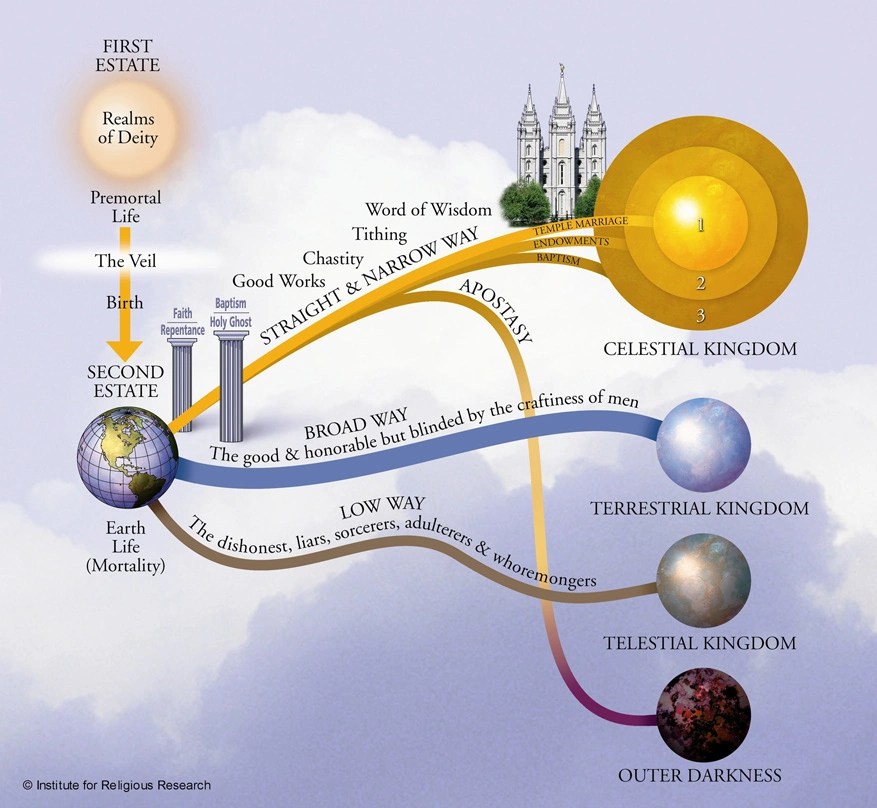
As I understand the church’s teaching, the “plan of salvation” begins when a pre-existent or premortal spirit chooses to take a body and passes through the “veil of forgetfulness.” Mortal life is a test to see whether or not a person will be faithful and obedient. After death, all enter the spirit world, either in paradise or spirit prison. Because of the atonement, all will be in the resurrection. From there, our choices before the resurrection will determine our final destination. Those who did not go the “straight and narrow way” through faith, repentance, baptism, and the Holy Ghost would spend eternity in the Terrestrial kingdom if they went the “broad way” or the Telestial kingdom if they went the “low way.” Those who went the “straight and narrow way” will be in the Celestial kingdom. Those who were on the straight and narrow way but later apostatized are the only ones who will be cast into outer darkness. The following chart nicely outlines the “plan of salvation” taught by the Mormon church (Thanks to this website).
A Biblical Response
Despite the claim that Joseph Smith “restored” the gospel, one would be hard-pressed to find any resemblance. The “restored” gospel is like the true gospel the way a cabbage is like a head, the way a Tonka truck is like a dump truck, the way a kid’s bike is like a chopper. You have the form but not the function. Joseph Smith’s “restored” gospel is not the gospel.
The claim that men removed his teachings from the Bible is ludicrous, though very convenient. You won’t find the “gospel” he taught in any part of the Bible or in any record of the historic Christian church. Joseph Smith’s plan of salvation offers no hope to escape the wrath of God against our sins, no possibility of reconciliation with God the Father, nothing but eternal damnation in the lake of fire.
First, Joseph Smith’s plan of salvation rests entirely in the Church of Jesus Christ of Latter-Day Saints. “Proper priesthood authority,” the “restored gospel,” “the Melchizedek priesthood,” covenants, and Temple work are necessary elements, and all of these are vested in the LDS church. So, the Mormon gospel does not rest on Jesus Christ’s death, burial, and resurrection for anything more than “general salvation,” which (it claims) is universal, because “all will be in the resurrection.” According to Smith, the central event in all of history and the central reason Jesus entered our world amounts to little more than a token opportunity to participate in the afterlife. Jesus is like a free admission ticket to the County Fair. If you want to do anything at the Fair, you’ll need to pay for it yourself.
Second, this plan of salvation is performance-based. “Salvation is conditional, depending on an individual’s continuing in faithfulness, or enduring to the end in keeping the commandments of God.” “However, through the grace of God, all can be saved from their sins (see 2 Nephi 25:23; Helaman 5:10–11) as they repent and follow Jesus Christ.” And 2 Nephi 25:23 (referenced above) teaches that “it is by grace that we are saved, after all we can do.” “We believe that through the Atonement of Christ, all mankind may be saved, by obedience to the laws and ordinances of the Gospel.” [2] “All who have truly repented, been baptized, have received the gift of the Holy Ghost, have made the covenant to take upon themselves the name of Jesus Christ, and have felt His influence in their lives, can say that they have been born again.” “This exaltation requires that men receive the Melchizedek Priesthood, and that all Church members make and keep sacred covenants in the temple, including the covenant of eternal marriage.” All of these things are performance-based. None of these things rely on the work of Christ. Grace provides the extra filler to cover the flaws, but nobody needs to rely on God’s grace in the gospel to save their soul. No wonder the Mormon church has created such a performance pressure cooker – when your eternal state depends so much on checking all the boxes.
Third, Jesus Christ plays no part in the Mormon plan of salvation. His death, burial, resurrection, and ascension, His broken body and shed blood, and the work God sent Him to do, have no part in the Mormon plan of salvation. Go ahead and look at ANY LDS materials you have available and see how the church describes this plan of salvation. You will find plenty of references to Jesus and be told that you must believe in Him, have faith in Him, and follow Him. But this plan of salvation depends on you and the work you do. You won’t find a description of Christ’s vicarious atonement. You won’t find any reference to His work in bearing our sins and the wrath of God for those sins. You won’t find any mention of His precious blood, which satisfies God’s righteous demands for justice. You won’t see any mention of the blood of Christ cleansing you from your sins. You won’t read about God’s work in justifying sinners, pronouncing a legal declaration from the bench, declaring that you are acquitted of all your sins. You won’t read of any such thing.
Fourth, this is an impossible gospel. Any “gospel” that depends on a human institution (the LDS church) led by fallible men with ever-shifting and sometimes contradictory explanations, any “gospel” that relies on the performance of all of its ordinances and laws and covenants in order to be achieved, is impossible. I think you feel the stress of it, the impossibility of it. Even if your church approves of your effort (as indicated by the “Temple recommend”), I think you know that your performance falls woefully short of the mark. I don’t criticize you for feeling inadequate in this. That feeling just might be the spur that drives you to Christ.
Wherefore the law was our schoolmaster to bring us unto Christ, that we might be justified by faith. (Galatians 3:24)
A Contrast of “Gospels”
Joseph Smith in no way “restored” anything to the gospel. He added to it and, in doing so, perverted and corrupted it. His “plan of salvation” is no gospel at all. Rather, Paul’s curse, twice emphasized, falls on him immediately and directly.
I marvel that ye are so soon removed from him that called you into the grace of Christ unto another gospel: Which is not another; but there be some that trouble you, and would pervert the gospel of Christ. But though we, or an angel from heaven, preach any other gospel unto you than that which we have preached unto you, let him be accursed. As we said before, so say I now again, If any man preach any other gospel unto you than that ye have received, let him be accursed. (Galatians 1:6-9)
The gospel does not consist of doctrines, ordinances, or principles to believe or follow. The gospel is an event that happened. Paul details that event in I Corinthians 15, which gives the most direct explanation of the gospel in the Bible. The word gospel means “good news.” And that good news is more than information. It is a historical event which took place at the cross.
Moreover, brethren, I declare unto you the gospel which I preached unto you, which also ye have received, and wherein ye stand; By which also ye are saved, if ye keep in memory what I preached unto you, unless ye have believed in vain. For I delivered unto you first of all that which I also received, how that Christ died for our sins according to the scriptures; And that he was buried, and that he rose again the third day according to the scriptures: (I Corinthians 15:1-4)
The gospel is not a map of our lives, traced from the spirit world before birth to our final destination in one of the kingdoms (or in outer darkness). The gospel isn’t what we do. The gospel is what Jesus did. Jesus entered our world. That isn’t a platitude; it is a historic event. His feet walked on the same earth we walk. His birth and life and death are chronicled in the gospel accounts of Matthew, Mark, Luke, and John. He went about doing good. He did no sin, neither was guile found in his mouth (I Peter 2:22). He laid down His life for the sheep (John 10:15, 17-18). He died for our sins. He bore God’s wrath against them (Isaiah 53:4-6, 10-11). He is the propitiation for our sins (Romans 3:24-26; I John 2:2, 4:10). His bloody sacrifice satisfied God’s demands for justice against our sin so that God would lay aside His wrath and extend us a pardon. All of this was done by the work of Jesus; none of it by us. The sin was ours, the guilt was ours, the desperate need was ours, and the saving work was His, from start to finish, from beginning to end. The gospel is the climax of His life, and of all history.
“According to Christian belief, Jesus is our Savior, not by virtue of what He said, not even by virtue of what He was, but by what He did. He is our Savior, not because He has inspired us to live the same kind of life that He lived, but because He took upon Himself the dreadful guilt of our sins and bore it instead of us on the cross. Such is the Christian conception of the Cross of Christ.” (J. Gresham Machen)
[1] https://www.churchofjesuschrist.org/study/manual/gospel-topics/restoration-of-the-church-study-guide?lang=eng
[2] From the third in the list of Articles of Faith at https://www.churchofjesuschrist.org/study/scriptures/pgp/a-of-f/1?lang=eng
 The Village Smithy